

Most school trustees in India still open the month-end with a knot in their stomach. The accountant’s desk is buried under printed fee receipts, concession lists, and handwritten ledgers. Furthermore, the finance report the principal needs by Monday morning takes three people and two days to compile. However, it does not have to work this way anymore.
Cloud-based School ERP platforms like EduTinker are changing how CBSE, ICSE, and state-board schools in India handle their finances. Moreover, with NEP 2020 pushing institutions toward digital governance, the pressure to modernise financial reporting is now stronger than ever.
The Real Problem: Why Manual Finance Reports Fail Schools
Most school owners will recognise these pain points immediately. First, fee data lives in disconnected systems, Tally, Excel sheets, and handwritten registers, making reconciliation a nightmare. Second, generating term-wise or year-wise income statements takes days instead of minutes. Third, scholarship and concession records are scattered, making audits extremely stressful. Additionally, errors in GST reporting or TDS compliance can invite regulatory trouble.
Therefore, the question is not whether to digitise, but how quickly you can afford to do it.
How Cloud ERP Transforms School Financial Reporting
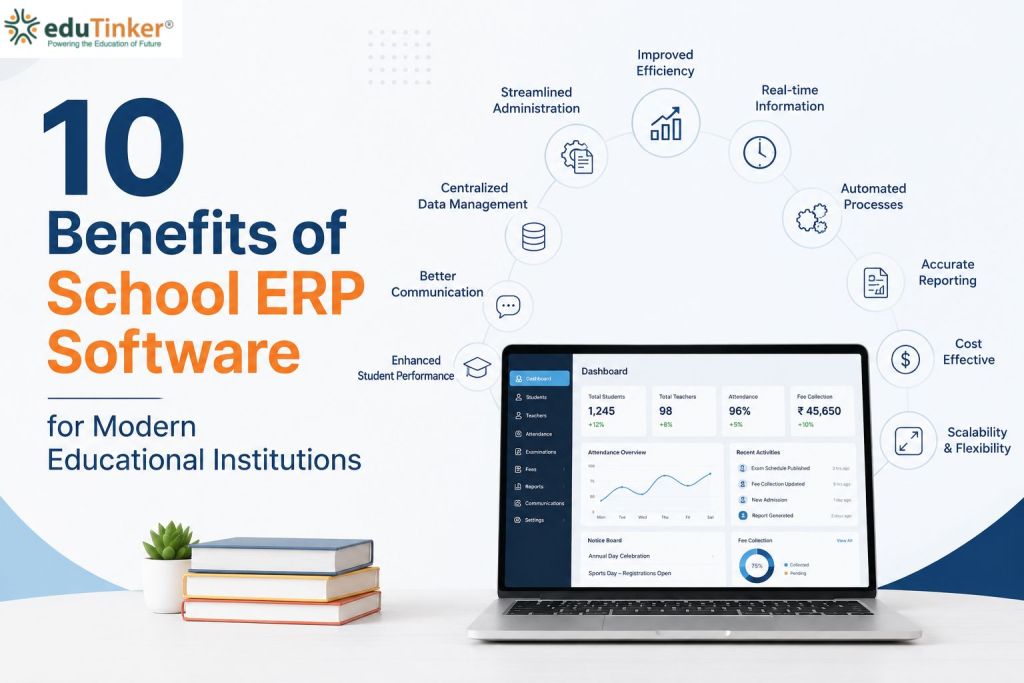
A cloud-based school ERP system consolidates every financial touchpoint, from fee collection and concession approvals to vendor payments and payroll, into a single, real-time dashboard. Consequently, trustees and principals can generate accurate financial reports in seconds, not days.
With EduTinker’s school finance module, your team can view outstanding fee summaries by class, section, or student within moments. Similarly, income-expense comparisons across terms are available at a click. Moreover, the system flags overdue payments automatically, so your accounts team can focus on exceptions rather than manual tracking.
Real-Time Dashboards Built for Indian School Principals
Indian school principals often juggle academics, administration, and finance simultaneously. Therefore, a good ERP dashboard must present financial data without jargon. EduTinker’s cloud interface gives principals a live view of daily fee collections, pending dues, and scholarship disbursements, all on one screen. Furthermore, multi-branch school networks can consolidate data from every campus into a single report, which is invaluable for trustees managing multiple institutions.
NEP 2020 and the Push Toward Digital Financial Accountability
NEP 2020 explicitly encourages schools to adopt technology-driven governance. In addition, regulatory bodies and state education departments increasingly expect digital audit trails. A cloud-based ERP ensures that every financial transaction is timestamped, role-based, and fully traceable. As a result, your school is always audit-ready, whether for a CBSE inspection or a state government review.
Compliance Made Simple: GST, TDS, and Beyond
For schools running hostels, transport services, or canteens, GST compliance is a genuine concern. Additionally, staff payroll involves TDS deductions that must be reported accurately. EduTinker’s financial module handles these calculations automatically. Consequently, your accountant spends less time computing taxes and more time on strategic planning.
Why EduTinker Is the Right Choice for Indian Schools
EduTinker is built specifically for the Indian school ecosystem. It understands the nuances of CBSE, ICSE, and state-board fee structures, scholarship norms, and audit requirements. Moreover, the platform offers a mobile-first interface, meaning school owners can review financial reports from anywhere, even on a Sunday evening before a Monday board meeting.
In conclusion, smart financial reporting is not a luxury for elite schools anymore. Rather, it is a baseline expectation that every school, from a 300-student rural institution to a 5,000-student urban chain, should meet in 2026.