

Walk into most Indian school staff rooms and you will find teachers making decisions based on gut feeling. They know which students are struggling. They identify weak subjects by memory. However, when a principal asks for data to back those observations, the answer is usually a physical register or a manually compiled Excel sheet, both slow and error-prone.
This is changing. School analytics tools are giving Indian educators something powerful: real-time, reliable data about student performance, attendance patterns, and academic trends. As a result, decisions that once took weeks of report compilation now happen instantly. Let us explore what this means for Indian schools in practice.
Why Data-Driven Decisions Matter More Than Ever in Indian Education
India’s education landscape is deeply competitive. Parents compare academic results, co-curricular achievements, and board exam pass rates before choosing a school. Additionally, CBSE and ICSE boards now emphasise continuous and comprehensive evaluation (CCE), requiring schools to track student progress beyond annual exams.
For a school principal, having access to analytics means being able to answer key questions quickly. Which students are at risk of failing before exams arrive? Which subjects are consistently weak across a particular grade? Are attendance patterns affecting academic outcomes? Without data, these questions require weeks of manual analysis. With analytics, the answers are available in seconds.
What School Analytics Software Covers
Modern school analytics tools integrated within a school ERP go well beyond basic report cards. Here is a breakdown of what they track:
Student-level performance tracking monitors marks across every test, assignment, and term exam. Consequently, teachers can spot a declining trend early and intervene before a student falls too far behind. Colour-coded dashboards make it easy to identify students needing support without reading through lengthy spreadsheets.
Class and subject-level analysis allows department heads to compare performance across sections. If Class 8A consistently scores lower in Mathematics than 8B, the data surfaces this pattern immediately. Therefore, principals can investigate whether it is a teaching methodology issue, a syllabus pacing problem, or something else.
Attendance correlation analysis links presence patterns with academic performance. Research consistently shows that attendance gaps predict learning gaps. Because school analytics tools in India now map this connection automatically, schools can reach out to parents of frequently absent students before the damage becomes irreversible.
Term-on-term trend reports allow school management to assess whether learning outcomes are improving year after year. Moreover, they help trustees evaluate whether academic investments new teachers, curriculum tools, or training programmes are translating into better results.
How Analytics Helps Indian School Principals Specifically
For school principals managing 500 to 3,000 students, analytics transforms an overwhelming job into a manageable one. Instead of depending on individual teacher reports that vary in quality and timeliness, principals can access a unified academic dashboard each morning.
Furthermore, analytics supports fair, evidence-based teacher evaluation. Rather than relying on subjective observation, principals can see which classes and subjects are improving and which are stagnant. This creates a culture of accountability without creating anxiety, because teachers can also see their own data and work towards improvement.
In terms of parent communication, analytics gives teachers solid evidence when discussing a child’s performance with parents. Instead of saying ‘your child seems to be struggling,’ a teacher can show a parent exactly where performance dipped, when attendance fell, and what the correlation looks like. This makes parent-teacher meetings more productive and trust-building.
Analytics and CBSE or ICSE Compliance in India
CBSE schools in India are required to maintain detailed academic records for affiliated schools’ inspection. Similarly, ICSE schools must produce structured performance data upon request. A school analytics module within a school ERP automates this record-keeping, ensuring that required reports are always ready and never dependent on manual compilation.
Additionally, analytics tools help schools prepare for CBSE’s continuous assessment requirements by creating a documented evidence trail for every student’s learning journey across the academic year.
Making Analytics Accessible to Teachers, Not Just Principals
One of the most important shifts that good school analytics software enables is putting data in teachers’ hands, not just administrators’. When every class teacher can see their students’ performance, attendance, and engagement data through a simple dashboard, they become more proactive.
Moreover, teachers who use analytics tend to personalise instruction more effectively. They identify which students need extension challenges and which need remedial support without waiting for exam results to confirm what the data already shows.
The EduTinker Approach to School Analytics in India
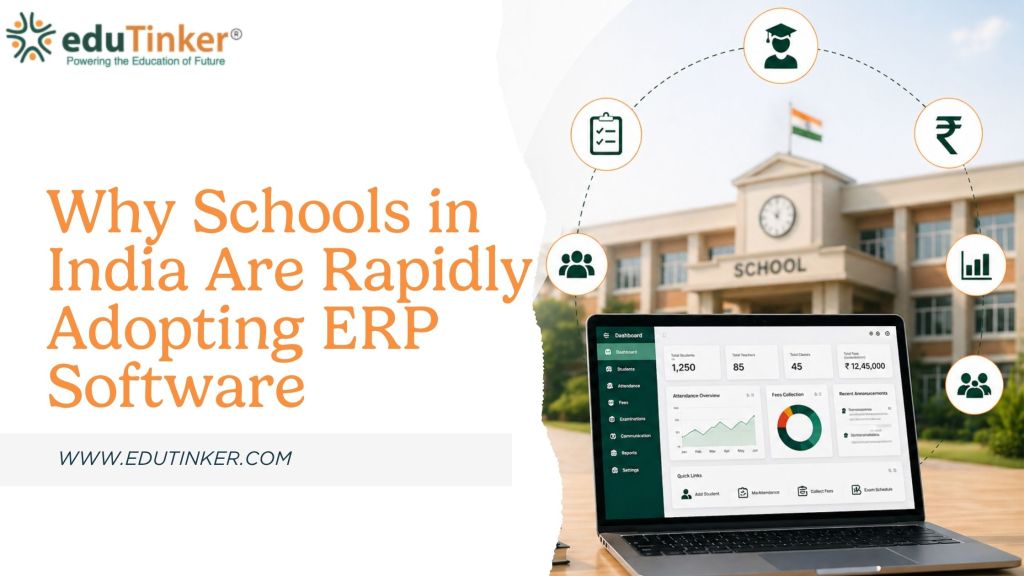
EduTinker’s 360-degree school analytics module is designed with the Indian school principal in mind. It consolidates academic, attendance, and fee data into a single dashboard accessible from any device. Because it integrates with the school ERP, data flows automatically without manual entry. School owners and trustees can review campus-wide or branch-wise performance through clean visual reports, helping them make strategic decisions about academic investment and resource allocation.
Conclusion
Indian schools are sitting on a wealth of data but without the right tools, that data stays locked in paper registers and disconnected spreadsheets. School analytics software unlocks this potential, giving principals, teachers, and trustees the clarity they need to improve student outcomes. For CBSE and ICSE schools in India looking to raise academic standards, build parent trust, and demonstrate consistent improvement, investing in school analytics is a decision that pays dividends every single term.