

Managing a school involves much more than conducting classes and maintaining academic records. From handling student admissions and fee payments to tracking attendance, managing examinations, and communicating with parents, schools have several responsibilities to manage every day.
As schools grow, managing information across different departments becomes even more demanding. This is where School ERP software becomes useful.
Let’s explore how School ERP software works, its key features and benefits, and how schools can select the right platform for their requirements.
School ERP software is a digital platform that helps educational institutions manage their daily academic and administrative activities in one place. It connects different departments, making it easier to maintain student records, track fees, manage attendance, organise examinations, and handle other school operations.
Instead of relying on separate registers and spreadsheets, schools can store, update, and access important information through a centralised system. For example, student details entered during admission can be used across relevant modules, reducing repeated data entry and saving administrative time.
A typical School ERP system includes features such as:
- Student Information and Admission Management
- Fee Management and Online Payments
- Attendance and Academic Management
- Examination and Result Management
- Staff and Payroll Management
- Parent-Teacher Communication
- Learning Management System (LMS)
- School Analytics and Reporting
With cloud-based accessibility, authorised users can access relevant information through internet-connected devices. This allows administrators, teachers, and parents to stay connected and manage their respective responsibilities more conveniently.
In simple terms, School ERP software brings essential school operations together, helping institutions manage their activities with better coordination and efficiency.
Many schools still depend on spreadsheets, paper registers, physical documents, and multiple disconnected applications to manage their daily activities. Although these methods may work for smaller operations, they can become difficult to maintain as student enrolments and administrative responsibilities increase.
School ERP software addresses these challenges by bringing essential information and processes together.
Here are some important reasons why schools should consider adopting an ERP system.
Reduces Manual Administrative Work
Managing student records, attendance, fees, and reports manually takes time and increases the chances of errors. School ERP software automates routine tasks, reducing paperwork and administrative effort.
Keeps School Information Organised
A centralised ERP system stores student details, attendance, fee records, and academic information in one place, making data easier to access and manage.
Improves Parent-School Communication
School ERP software helps schools share attendance updates, academic progress, fee notifications, and important announcements with parents through digital communication tools.
Makes Fee Management Easier
Digital fee management simplifies fee collection, instalment tracking, payment records, receipts, and reminders, helping schools manage finances more efficiently.
Supports Better Decision-Making
With centralised reports and school analytics, administrators can monitor daily operations, review performance, and make informed decisions based on accurate information.
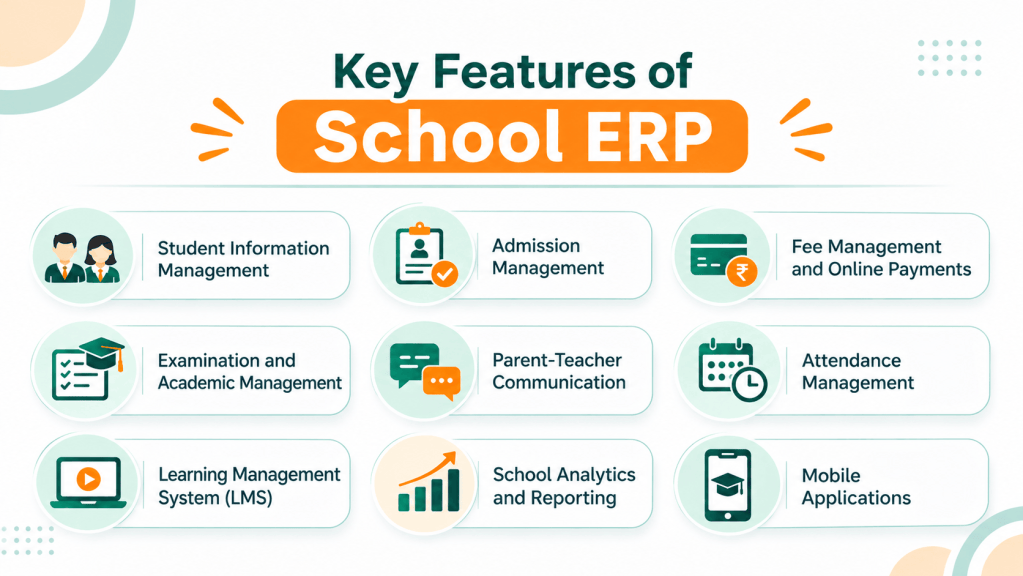
Not every School ERP system offers the same capabilities. Schools should look for a platform that covers their academic, administrative, financial, and communication needs.
Some essential features include:
Student Information Management
Helps schools maintain student profiles, contact details, academic records, and other important information in one centralised database.
Admission Management
Simplifies applicant registration, document collection, application tracking, and enrolment, reducing paperwork and making the admission process more organised.
Fee Management and Online Payments
Allows schools to manage fee structures, instalments, online payments, receipts, pending dues, and payment reminders through a single system.
Examination and Academic Management
Helps schools organise examination schedules, record marks, manage assessments, and generate student performance reports.
Parent-Teacher Communication
Makes it easier to share school announcements, attendance updates, academic information, and important notifications with parents.
Attendance Management
Simplifies employee record management, staff attendance, leave tracking, and payroll-related activities.
Learning Management System (LMS)
Supports digital learning by allowing teachers to share study materials, assignments, and educational resources with students.
School Analytics and Reporting
Provides dashboards and reports covering admissions, fee collection, attendance, and academic performance to support informed decision-making.
Mobile Applications
Dedicated apps for parents, teachers, and students provide convenient access to relevant school information and improve communication.
School ERP software does more than simplify administrative work. Its benefits extend to everyone involved in the educational environment.
Let’s understand how different stakeholders benefit from using an integrated School ERP system.
Benefits for School Owners and Administrators
An ERP platform gives school management better visibility into daily operations and helps reduce administrative workload.
- Better operational control: Monitor different departments through one platform.
- Reduced workload: Automate repetitive administrative tasks.
- Financial visibility: Track fee collections and outstanding dues.
- Better decisions: Use reports and analytics to review school performance.
- Improved coordination: Connect academic and administrative departments.
Benefits for Teachers
School ERP software helps teachers manage attendance, examination records, marks, and learning resources digitally. This reduces routine administrative work and gives teachers more time to focus on classroom teaching and student development.
Benefits for Parents
Parents can receive attendance updates, check fee details, access school announcements, and stay informed about their children’s academic progress through dedicated communication tools and mobile applications.
Benefits for Students
Students can conveniently access digital learning materials, assignments, examination schedules, and other academic information, helping them stay organised and manage their learning activities.
Choosing the right School ERP software requires understanding your institution’s needs and evaluating how well a platform meets them. Here are some important factors to consider before making a decision.
Understand Your School’s Requirements
Identify the areas where your school needs improvement, whether admissions, fee management, attendance, academics, or parent communication. Choose software that addresses these requirements.
Check the Available Features
Look for essential modules covering student records, admissions, fees, attendance, examinations, communication, and reporting. Prioritise useful features over simply having more options.
Look for an Easy-to-Use Interface
The platform should be simple to navigate for administrators, teachers, parents, and students. An intuitive interface also makes adoption easier.
Consider Cloud Accessibility
Cloud-based School ERP software allows authorised users to access information through internet-connected devices, offering greater flexibility in managing school operations.
Evaluate Data Security
Check for secure data handling, user permissions, access controls, and backup arrangements to protect important student, staff, and financial information.
Check Customisation and Scalability
Choose a platform that can adapt to your school’s fee structures, admission procedures, and administrative processes while supporting future growth.
Evaluate Customer Support
Reliable technical support, implementation assistance, and user training can make software adoption easier and help schools get the most out of their ERP system.
Managing different school activities becomes easier when the right technology brings everything together. This is where eduTinker helps educational institutions simplify their academic and administrative operations.
eduTinker is a School ERP and Management Software designed to support the changing needs of Indian schools. Its integrated platform brings essential school functions together, helping administrators, teachers, parents, and students stay connected.
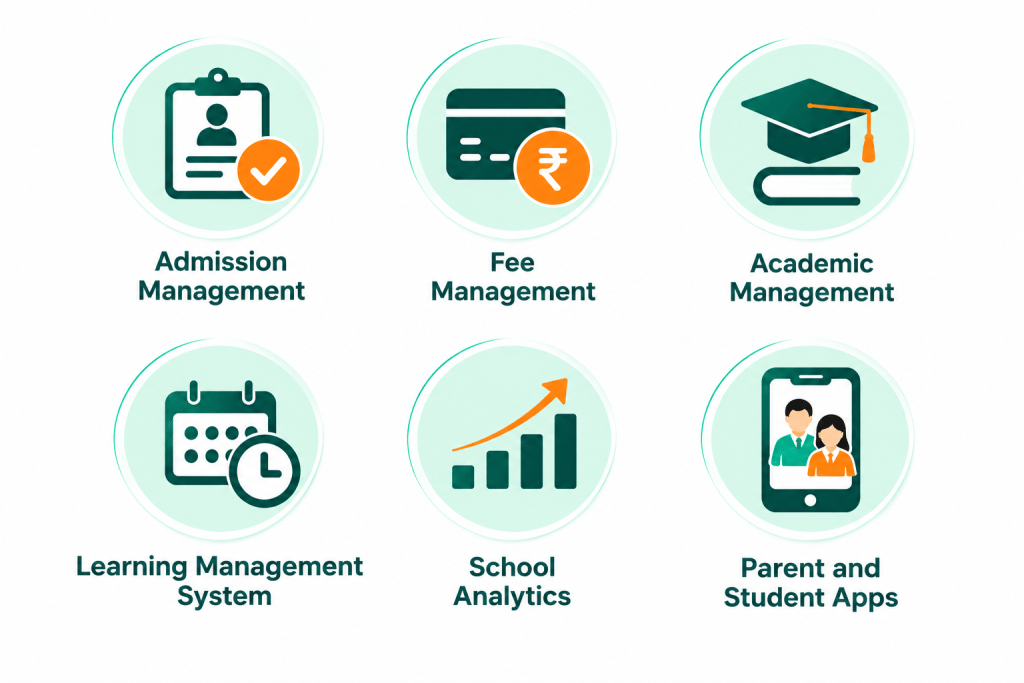
Some of the capabilities offered by eduTinker include:
- Admission Management: Organise applicant registration, admission records, and enrolment activities.
- Fee Management: Manage fee structures, online payments, receipts, and outstanding dues.
- Academic Management: Support academic activities, examination processes, and student records.
- Learning Management System: Provide access to digital learning resources and academic content.
- School Analytics: Access reports and dashboards to gain a clearer view of school operations.
- Parent and Student Apps: Improve accessibility and communication through mobile applications.
With cloud-based accessibility, integrated modules, and features designed for different school stakeholders, eduTinker helps institutions move towards more organised and connected school management.
Explore the platform at Edutinker to learn more about its School ERP capabilities.