
Managing a school requires a balance between academic excellence and smooth administration. From handling admissions and student attendance to collecting fees, managing teachers, and communicating with parents, school administrators have several responsibilities to manage every day.
As schools grow, these tasks can become more complicated. Paperwork, disconnected software, and repetitive data entry may slow down daily operations and make it difficult to maintain accurate records. These challenges can affect not only administrative efficiency but also the experience of teachers, students, and parents.
This is why many educational institutions are exploring School ERP software to simplify their work and bring important school activities together on a single platform.
In this blog, we will explore the most common school management challenges and understand how the right ERP solution can help schools overcome them.
School management challenges are the administrative, academic, and operational problems that make it difficult for schools to function efficiently. These include managing student records, processing admissions, tracking fees, monitoring academic performance, coordinating staff, and maintaining effective communication with parents.
A well-integrated school management system can help schools organise these activities, reduce manual work, and improve access to important information.
1. Managing Student Records and Information
Maintaining accurate student records is one of the most common challenges for school administrators. Information such as admission details, attendance, examination results, fee payments, and student documents must be updated regularly.
When schools depend on registers, spreadsheets, or separate software tools, finding information can take time. Staff may also have to enter the same details more than once, increasing the chances of errors.
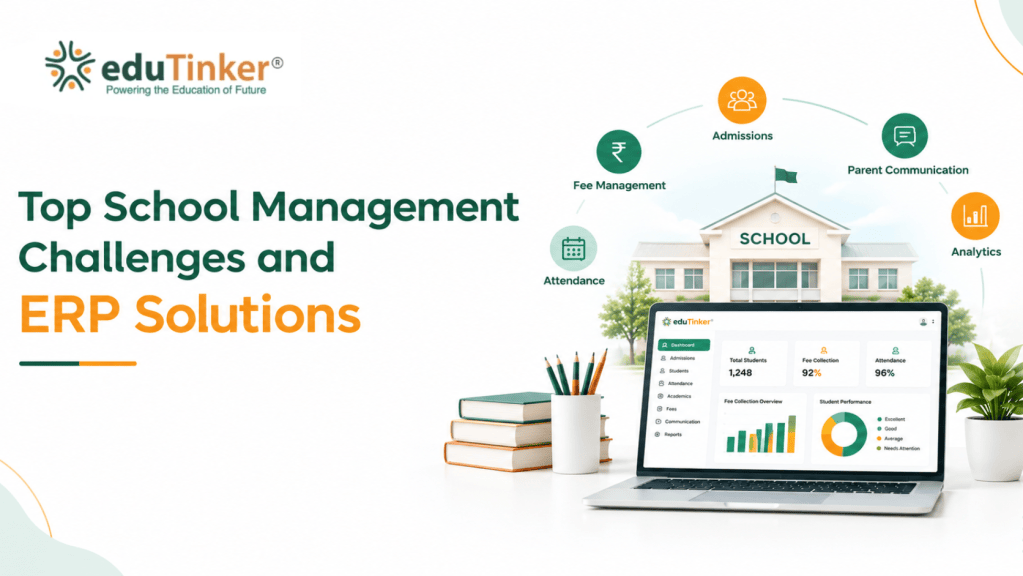
Edutinker ERP solution: School ERP software helps centralise student information in a digital system. Authorised staff can access relevant records when required, making it easier to maintain student profiles, monitor attendance, and review academic information.
With eduTinker’s School Management System, schools can manage important academic and administrative activities through an integrated platform.
2. Complicated Admission Management
The admission process involves several steps, including handling enquiries, collecting application forms, verifying documents, tracking registrations, and confirming admissions. Managing these activities manually can become challenging during peak admission periods.
Missed follow-ups and delayed responses may also affect the admission experience for parents.
Edutinker ERP solution: Admission management software helps schools organise enquiries, registration forms, documents, and application status in one place. It also allows administrators to monitor different admission stages and understand where applications may be dropping off.
eduTinker’s Admission Management module supports online and offline enquiry management, customised admission processes, registration, document collection, and admission dashboards.
This helps schools manage applications more systematically and reduce the administrative effort involved in admissions.
3. Delays in School Fee Collection
Fee management requires schools to handle different fee structures, instalments, concessions, outstanding dues, receipts, and payment records. When these activities are managed manually, tracking pending payments and preparing collection reports can become time-consuming.
Parents may also need a convenient way to check fee schedules and complete payments.
Edutinker ERP solution: School fee management software helps automate fee calculations, maintain payment records, generate receipts, and track outstanding dues. Depending on the available features, it can also support online payments and automated reminders.
With eduTinker Fee Management, schools can configure fee structures, track previous-year dues, review collection dashboards, and manage fee reports. Parents can also access fee schedules and online payment facilities.
An organised fee management process gives school administrators better visibility into collections and helps reduce repetitive financial administration.
4. Tracking Attendance and Academic Performance
Regular attendance and academic progress are important for understanding how students are performing. However, maintaining attendance registers, calculating percentages, preparing report cards, and reviewing examination results can require significant effort.
When this information is scattered across different records, teachers may find it difficult to identify students who need additional support.
Edutinker ERP solution: A school management system can simplify attendance tracking, examination management, assignment evaluation, and report card preparation.
eduTinker provides features such as automated attendance, test creation, assignment sharing, evaluation, and report card generation. Its School Analytics module also helps schools review student attendance, submissions, test scores, and academic progress.
These insights can help teachers identify learning gaps and support students more effectively.
5. Poor Communication Between Schools and Parents
Parents want to stay informed about their children’s attendance, examination results, school announcements, and academic progress. However, communicating through separate messaging groups, phone calls, and printed notices can lead to missed updates.
Teachers and administrators may also spend considerable time responding to repeated queries.
Edutinker ERP solution: School ERP software with parent communication features provides a more organised way to share school updates. Depending on the platform, schools can send announcements, attendance notifications, examination information, and fee reminders through digital channels.
eduTinker supports communication between teachers, parents, students, and administrators through its platform. This helps parents stay informed while making it easier for school staff to share relevant information.
Better communication can strengthen parent engagement and create greater transparency in school operations.
6. Managing Teachers and Daily Academic Activities
Teachers have responsibilities beyond classroom teaching. They need to prepare lessons, manage assignments, record attendance, evaluate students, and communicate with parents. When administrative work takes up too much time, it can reduce the time available for teaching and student support.
Edutinker ERP solution: School management software can help teachers organise their daily schedules and academic activities. Digital tools for attendance, assignments, tests, study materials, and performance reports reduce the need for repetitive manual work.
eduTinker offers teaching and learning tools that support assignment sharing, online tests, automated grading, study material distribution, and access to timetables.
By simplifying routine tasks, schools can help teachers focus more on classroom engagement and student development.
7. Difficulty in Preparing Reports and Making Decisions
School owners and principals need reliable information to understand how their institutions are performing. They may need to review admission numbers, fee collections, attendance, examination results, and other operational details.
Preparing these reports manually can delay important decisions and make it difficult to identify patterns.
Edutinker ERP solution: School analytics software helps organise school data into useful reports and dashboards. Administrators can review available information, monitor key activities, and identify areas that require attention.
Through eduTinker School Analytics, school leaders can gain insights into admissions, fee collections, attendance, and student performance.
Access to organised information supports more informed decision-making and helps schools plan improvements based on their operational needs.
8. Managing School Transport and Other Operations
School administration also includes coordinating transport routes, assigning students to stops, managing timetables, organising events, and maintaining library records. When these activities are handled separately, staff may find it difficult to keep information updated.
Edutinker ERP solution: An integrated school ERP platform can bring multiple operational activities together. Depending on the system, this may include transport management, route planning, library records, timetable management, and school announcements.
eduTinker includes features for managing transport routes, mapping students to stops, accessing timetables, and organising school activities.
Bringing these functions into a connected system can improve coordination and make everyday school operations easier to manage.
Not every school has the same requirements. Before selecting school management software, administrators should understand their existing challenges and identify which processes need improvement.
Here are some important factors to consider:
- Ease of use: Teachers, administrators, and parents should find the platform easy to navigate.
- Integrated features: Look for admission management, fee management, attendance, academics, communication, and reporting tools that match your school’s needs.
- Data security: Review access permissions, backup practices, and how student and financial information is protected.
- Reporting capabilities: Check whether the software provides useful dashboards and reports for school management.
- Mobile accessibility: Mobile access can help parents, teachers, and students stay updated.
- Scalability: Choose a system that can support your institution as its student population and operational requirements grow.
- Customer support: Training and reliable assistance can make implementation easier for school staff.
The right School ERP system should address real administrative challenges rather than introduce unnecessary complexity.
eduTinker provides an integrated school management platform designed to help educational institutions manage academic and administrative activities more efficiently.
From admission management and fee collection to attendance, academic activities, parent communication, and school analytics, eduTinker helps bring essential school processes together.
Its features support different stakeholders across the school community. Administrators can access relevant operational information, teachers can manage academic activities, and parents can stay informed about fee schedules and student progress.
For schools looking to reduce manual work and improve coordination, eduTinker offers a practical way to explore digital school management.
Visit eduTinker.com to explore its school ERP solutions and discover how an integrated platform can support your institution’s needs.