
Managing a school today involves much more than teaching students. School administrators have to manage admissions, student records, attendance, examinations, fee collection, staff information, parent communication, and many other daily activities. When these processes are handled manually or through separate systems, it can become difficult to keep information organised and accessible.
This is where School ERP software and Cloud ERP solutions can make a significant difference. A modern cloud-based School ERP brings important school operations together on one platform, allowing administrators, teachers, parents, and students to access relevant information more easily.
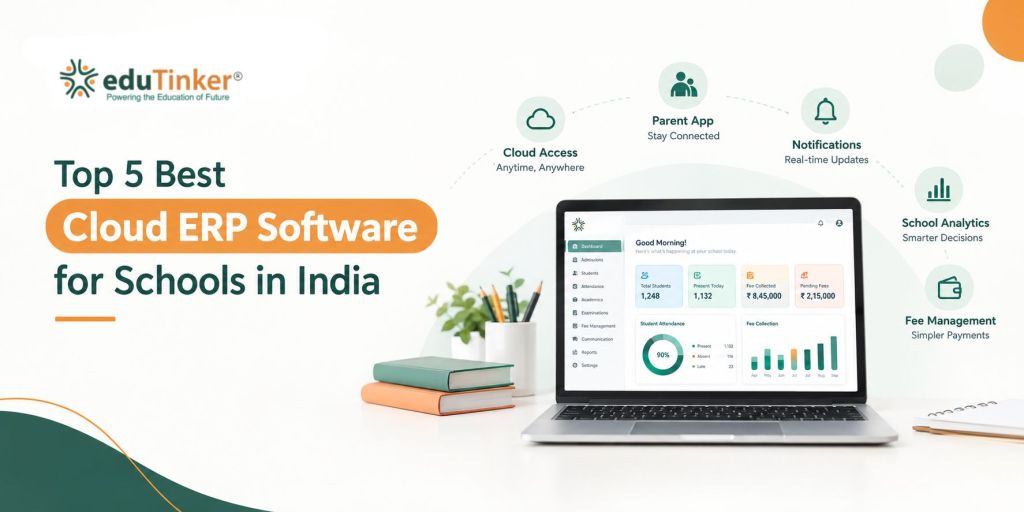
For Indian schools, choosing the right Cloud ERP for schools is becoming increasingly important. Schools need software that is secure, easy to use, accessible from different devices, and capable of supporting everyday operations such as fee management, school analytics, parent communication, notifications, attendance, academics, and student information management.
Here are five School ERP and Cloud ERP solutions that schools in India can consider.
eduTinker is an integrated School ERP and Cloud ERP platform designed to help educational institutions manage their academic and administrative activities from a single system.
Being cloud-based means schools can access relevant information without depending entirely on locally installed software. This can be particularly useful for administrators and school leaders who need access to reports and information across different devices.
One of the important strengths of a modern School ERP is its ability to connect schools with parents. eduTinker’s parent app helps schools provide parents with easier access to important school-related information and updates.
The platform can support areas such as admissions, student information, attendance, academics, examinations, communication, and fee management. Schools can also use notifications to share important announcements and reminders with parents and other stakeholders.
Fee Management
Managing fees is one of the most important administrative responsibilities for schools. A digital fee management system can simplify fee structures, instalments, online payments, reminders, receipts, outstanding dues, and financial reporting.
With these processes managed digitally, school administrators can spend less time maintaining manual records and parents can get a more convenient way to manage fee-related requirements.
School Analytics
A school generates a large amount of information every day. School analytics can help administrators turn this data into useful reports and insights.
Data related to attendance, fees, academics, admissions, and other school activities can provide school leaders with better visibility into daily operations and help them make more informed decisions.
Key features of eduTinker
- Cloud-based School ERP
- Parent app and digital communication
- Fee management and online fee collection
- Attendance management
- Student information management
- Academic and examination management
- Notifications and parent engagement
- School analytics and reports
- Centralised school administration
For schools looking for an integrated Cloud ERP solution instead of multiple disconnected tools, eduTinker can be a strong option.
Fedena is a school management platform that provides tools for handling academic and administrative activities.
Its functionality covers areas such as student management, attendance, examinations, fees, communication, and other school operations. A centralised ERP approach can help schools reduce dependence on spreadsheets and manual processes.
For schools considering a cloud-based ERP system, accessibility, usability, data security, and support are important factors to evaluate before making a final decision.
Vidyalaya is a comprehensive Cloud ERP for schools that brings academic, administrative, financial, and communication activities together on a single platform. Its cloud-based setup allows authorised users to access school information from different locations while keeping departments connected through a central system. Schools can manage admissions, student records, attendance, academics, examinations, fee management, HR, transport, library, and reporting through integrated modules. Vidyalaya also supports parent and student apps, dashboards, notifications, and communication tools, helping schools keep families informed and improve engagement. With reporting and data insights available within the platform, school management can get better visibility into everyday operations and make more informed decisions.
SchoolCanvas is a school management solution designed to support academic and administrative activities.
A modern School ERP should reduce repetitive administrative work while keeping important information organised. Digital tools for student records, attendance, fees, communication, and academics can help schools create a more structured workflow.
For institutions moving towards digital administration, a Cloud ERP for school management can also provide the convenience of accessing information without being tied to a single computer or location.
Entab provides school management solutions covering different academic, administrative, communication, and financial requirements.
Modern schools increasingly need better ways to communicate with parents. Digital notifications, alerts, parent access, and communication tools can make it easier to keep families informed.
The platform also supports areas related to student information, attendance, academics, fees, and school administration.
What Is Cloud ERP for Schools?
A Cloud ERP is an enterprise resource planning system hosted online rather than being dependent on software installed on individual school computers.
For schools, this means administrators and authorised users can access the system through internet-connected devices. Instead of keeping different records on separate computers, schools can manage information through a centralised digital platform.
A Cloud-based School ERP can bring functions such as student management, attendance, fee management, academics, communication, and reporting together.
This approach can be especially useful for schools with multiple departments or campuses that need better coordination and access to centralised information.
Why Should Schools Choose a Cloud-Based School ERP?
One of the biggest advantages of Cloud ERP is accessibility. School administrators may need to check information even when they are not sitting at their office computer.
A cloud-based platform can also make it easier to maintain a central source of information. When authorised users work from the same system, schools can reduce duplicated records and improve coordination between departments.
Another advantage is scalability. As a school grows, its requirements can change. A scalable School Management Software solution can support increasing student records, users, departments, and administrative requirements.
Parent App and Notifications
Communication between schools and parents is an important part of the modern education experience.
A parent app can give families convenient access to school-related information while reducing the need for repeated phone calls or physical notices.
Notifications can be used for important announcements, reminders, fee updates, attendance-related information, academic updates, and other school communications.
When communication is timely and accessible, it can contribute to stronger parent engagement.
Fee Management
Fee collection can become complicated when schools rely on manual registers, spreadsheets, or disconnected payment systems.
A School ERP with integrated fee management software can help schools manage fee structures, instalments, online payments, reminders, receipts, outstanding dues, and reports from one place.
Parents can also benefit from greater visibility into their fee status and easier access to digital payment options.
School Analytics
Schools collect data from almost every department. However, collecting data is only useful when school leaders can understand and act on it.
School analytics can help administrators review information related to attendance, admissions, fee collection, academics, examinations, and other operational areas.
Dashboards and reports can make important trends easier to identify and can support data-driven decision-making.
How to Choose the Best School ERP Software in India
Schools should not select an ERP simply because it has a long list of features. The software should fit the school’s actual requirements and be simple enough for administrators and teachers to use every day.
Before selecting a Cloud ERP for schools, consider:
- Ease of use and implementation
- Cloud accessibility
- Parent app functionality
- Notifications and communication
- Fee management capabilities
- School analytics and reporting
- Attendance and academic management
- Data security
- Mobile accessibility
- Scalability
- Customer support
The best School ERP is ultimately the one that solves real operational challenges without creating unnecessary complexity.
Final Thoughts
The move towards digital education is changing how schools manage their everyday operations. Cloud ERP and School ERP software can help schools move away from fragmented systems and bring important processes onto one platform.
Features such as parent apps, notifications, fee management, school analytics, digital communication, attendance, academics, and student information management can make school administration more organised and connected.
For Indian schools, the right Cloud-based School ERP should not only automate administrative work but also improve communication between schools and families. By choosing a secure, scalable, user-friendly platform, schools can build a more efficient digital environment while giving administrators, teachers, and parents better access to the information they need.