
The education sector is changing rapidly. Schools, colleges, and universities are moving beyond traditional administrative methods and adopting digital solutions to manage their everyday operations. From student admissions and fee collection to academic planning and institutional reporting, technology is making educational management more organised and efficient.
Artificial Intelligence (AI), automation, and cloud-based platforms are adding new possibilities to this transformation. Educational institutions now need systems that can simplify administrative responsibilities, improve access to information, and support better decision-making.
This is where AI-powered education technology and School & College ERP software become important. By bringing different institutional activities together on a unified platform, modern ERP solutions help administrators, teachers, students, and parents work more efficiently.
With integrated School ERP and College ERP solutions, eduTinker aims to simplify institutional management and support the digital transformation of educational institutions.
An Enterprise Resource Planning (ERP) system for educational institutions is a digital platform that connects different administrative and academic functions in one place.
A traditional management system may require institutions to use separate tools for admissions, attendance, examinations, fee collection, and communication. An integrated ERP platform brings these activities together, reducing repetitive work and making institutional information easier to manage.
When AI capabilities are introduced into education management, institutions can explore additional possibilities such as intelligent data analysis, automated workflows, predictive insights, and personalised learning support.
For example, analysing attendance patterns can help administrators identify students who may require additional attention. Similarly, reviewing fee collection reports can help management understand outstanding payments and plan follow-up activities.
AI does not replace the need for teachers or administrators. Instead, it can support them with useful information and reduce the time spent on repetitive tasks.
Educational institutions manage large amounts of information every day. Maintaining accurate student records, monitoring academic activities, coordinating staff, and managing financial operations can become challenging when different departments work independently.
A smart education management system helps address these challenges.
Simplified Administrative Operations
Managing admissions, student information, attendance, and fee records manually can consume valuable time. An integrated ERP system helps centralise these activities and reduces dependence on multiple spreadsheets and disconnected applications.
Better Access to Institutional Information
School owners, principals, and college administrators need reliable information to understand institutional performance. Centralised dashboards and reports make it easier to access relevant operational data and monitor important activities.
Improved Communication
Communication between institutions, teachers, students, and parents is essential. Digital platforms and mobile applications help share important updates, academic information, notifications, and payment-related details.
More Efficient Decision-Making
Institutions can use reports and analytics to understand attendance trends, fee collection, academic performance, and other operational indicators. AI-assisted analysis can further support decision-making when relevant capabilities are available.
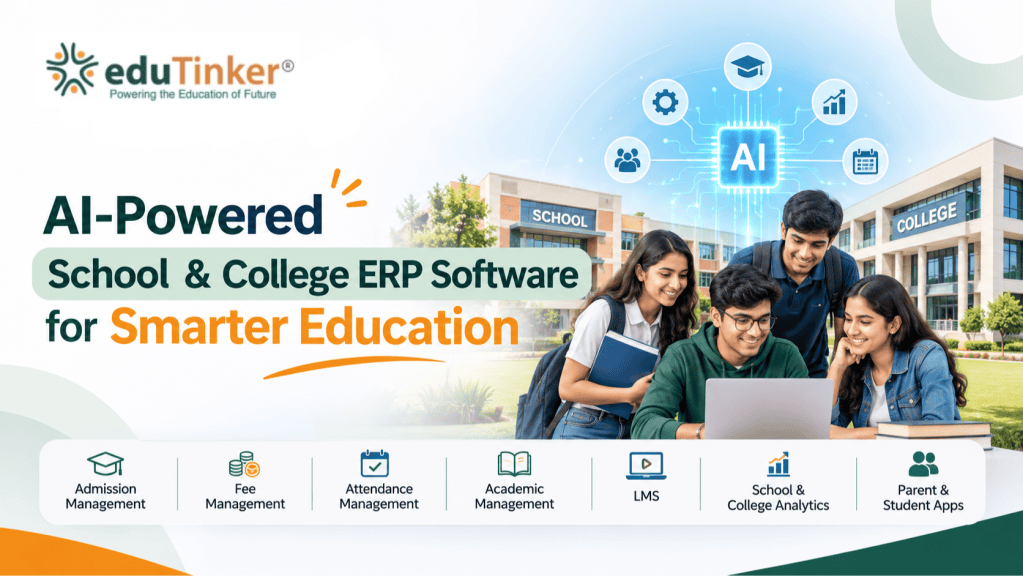
A modern education ERP platform should offer more than basic record management. It should connect essential institutional processes and provide a reliable digital environment for everyday activities.
Admission Management
Admissions are among the most important processes for any educational institution. Managing enquiries, registrations, applicant information, and admission records manually can create unnecessary delays.
Admission management software helps organise the admission journey, from initial enquiry to student enrolment. It allows institutions to maintain applicant records, monitor admission progress, and manage registration information more systematically.
Digital admission workflows also make it easier for institutions to handle applications and reduce paperwork.
Fee Management and Financial Operations
Financial management requires accuracy, transparency, and proper record-keeping. Schools and colleges need to manage fee structures, instalments, collections, outstanding dues, and payment receipts.
A digital fee management system helps institutions organise these activities through a centralised platform.
Automated payment reminders, online payment facilities, and collection reports can reduce manual follow-ups. When combined with reporting and analytics, these records can help administrators understand payment trends and monitor financial performance.
Attendance Management
Attendance is an important indicator of student participation and institutional discipline.
School and college ERP software helps maintain student and staff attendance records in an organised manner. Administrators can access attendance reports, while authorised teachers can manage attendance-related activities.
With appropriate analytical capabilities, institutions can also identify attendance patterns and recognise students who may need additional attention.
Academic and Examination Management
Academic administration involves multiple responsibilities, including examination schedules, grading, student performance records, and academic planning.
An integrated ERP system helps bring these activities together. Teachers and academic administrators can maintain examination records, organise assessments, and access student performance information.
For colleges and universities, additional academic requirements such as examination management, Outcome-Based Education (OBE), and CO-PO mapping can support structured academic monitoring and accreditation-related processes.
Learning Management System (LMS)
Digital learning is becoming an important part of modern education. A Learning Management System allows institutions to share educational resources, digital content, assignments, and learning materials through an online platform.
Teachers can organise learning resources, while students can access relevant academic content.
AI-enabled learning technologies can further support personalised learning experiences, content recommendations, and learning assistance when integrated into the platform.
School and College Analytics
Institutional data becomes more useful when it can be converted into meaningful information.
School analytics and college analytics help administrators understand different aspects of institutional performance through dashboards, reports, and visual summaries.
These insights can cover admissions, fee collection, attendance, academic activities, and other important operations.
AI-assisted analytics can extend this capability by identifying patterns and helping institutions explore possible areas for improvement.
Mobile Applications for Parents, Teachers, and Students
Educational management should not be limited to office computers. Mobile applications make important institutional information accessible to different stakeholders.
Parents can stay informed about relevant student updates, teachers can access academic information, and students can remain connected with learning resources and institutional notifications.
A connected mobile experience also improves communication between educational institutions and their communities.
AI is creating new opportunities for educational institutions beyond basic automation. When implemented responsibly, it can help institutions make better use of the information they already collect.
Data-Based Student Insights: AI-assisted analysis can help identify patterns in attendance, academic performance, and student engagement. Teachers and administrators can use these insights to recognise students who may benefit from additional support.
Predictive Admission Analysis: Historical admission information can help institutions understand enrolment trends, evaluate application patterns, and plan future admission activities.
Administrative Automation: Repetitive tasks such as notifications, reminders, and routine data processing can be supported through automation, allowing staff to focus on more important responsibilities.
Smarter Institutional Reporting: AI-supported reporting can help organise large amounts of institutional information and make relevant insights easier to interpret.
Personalised Learning Support: AI-based educational tools can support individual learning needs through adaptive resources, content recommendations, and additional learning assistance.
However, AI-generated insights should always be reviewed by responsible institutional staff. Student information must also be handled securely, with appropriate privacy controls and access permissions.
Using separate applications for different departments can create information gaps. Data may need to be entered repeatedly, reports may not match, and administrators may struggle to get a complete picture of institutional operations.
An integrated ERP platform addresses this problem by connecting different departments through a common system.
For schools, this means better coordination between admissions, fees, attendance, academics, examinations, and parent communication.
For colleges and universities, integration can extend to examinations, finance, academic administration, OBE processes, and institutional reporting.
A unified system also makes it easier for management teams to monitor operations without depending on information collected from multiple disconnected sources.
eduTinker is designed to help educational institutions manage their administrative and academic activities through an integrated digital platform.
Its School ERP and College ERP solutions bring essential institutional processes together, helping management teams simplify everyday responsibilities.
For schools, eduTinker offers capabilities covering admission management, fee management, attendance, academic administration, examinations, school analytics, and digital learning resources.
For colleges and universities, its ERP approach supports connected academic and administrative processes, including examination management, OBE-related activities, finance integration, and institutional reporting.
The platform also supports digital accessibility through mobile applications, helping parents, teachers, and students stay connected with their institutions.
By bringing essential functions together, eduTinker helps educational institutions reduce fragmented workflows and build a more organised management environment.
As AI and automation continue to influence education technology, integrated platforms provide an important foundation for institutions looking to adopt smarter digital processes.
Choosing an ERP platform is an important decision because it affects multiple departments and stakeholders. Institutions should evaluate their current requirements as well as their long-term digital goals.
Consider the following factors before selecting a solution:
- Integrated Functionality: Look for a platform that connects admissions, fees, attendance, academics, examinations, and reporting.
- AI and Automation Capabilities: Understand which AI features are actually available and how they support institutional activities.
- Data Security: Check access controls, data protection practices, and security arrangements.
- Ease of Use: Ensure that administrators, teachers, students, and parents can use the platform comfortably.
- Scalability: Choose a solution that can support institutional growth and changing operational requirements.
- Reporting and Analytics: Evaluate whether the system provides useful dashboards and reports for management.
- Mobile Accessibility: Check whether the platform offers convenient mobile access for relevant stakeholders.
- Customer Support: Reliable implementation assistance, training, and technical support are important for long-term adoption.
The right ERP software should match the institution’s operational needs rather than simply offering the largest number of features.
The future of education management will increasingly depend on connected technology, intelligent automation, and effective use of institutional data. AI can support this transformation by helping schools and colleges understand information, simplify repetitive activities, and explore better ways to manage their operations.
However, technology delivers the greatest value when it is supported by a strong management system. An integrated School and College ERP platform provides the foundation for connecting departments, improving communication, and making institutional information more accessible.
With its integrated ERP capabilities, eduTinker supports schools, colleges, and universities in moving towards more organised and digitally connected education management.
The goal is simple: make institutional management easier so educators and administrators can focus more on what matters most — delivering quality education.