
Top 7 School Management Software in India for 2027

Top 7 School Management Software for 2027

Managing a school involves more than academics. From student admissions and fee collection to attendance, examinations, and parent communication, educational institutions handle several activities every day. Managing these processes manually can increase administrative workload and make information difficult to track.

This is why schools are increasingly adopting school ERP software in India to automate routine tasks, organise records, and improve coordination between departments.

A good school management system brings essential operations together on one platform, helping principals, teachers, administrators, parents, and students access relevant information.

But with several ERP providers available, how do schools choose the right solution?

In this guide, we explore the Top 7 School Management Software in India for 2027, their key features, and what to consider when selecting the best ERP software for schools.

School management software is a digital platform that helps educational institutions manage academic, administrative, and financial activities. It replaces scattered registers and spreadsheets with a centralised system for maintaining student records, managing admissions, tracking attendance, collecting fees, and monitoring academic performance.

Modern school ERP software also supports parent communication, staff management, examination records, and school analytics.

Whether it is a private institution, public school, or growing school network, the right software can make daily administration more organised and efficient.

Here are seven school ERP platforms worth exploring when comparing features, functionality, and suitability for different institutions.

1. eduTinker – Integrated School Management Software

eduTinker offers an integrated school management platform designed to simplify academic and administrative operations. It brings essential school functions together, helping administrators, teachers, parents, and students stay connected through a centralised system.

Its platform supports admission management, fee collection, attendance, academic activities, digital learning, and school analytics.

Key Features:
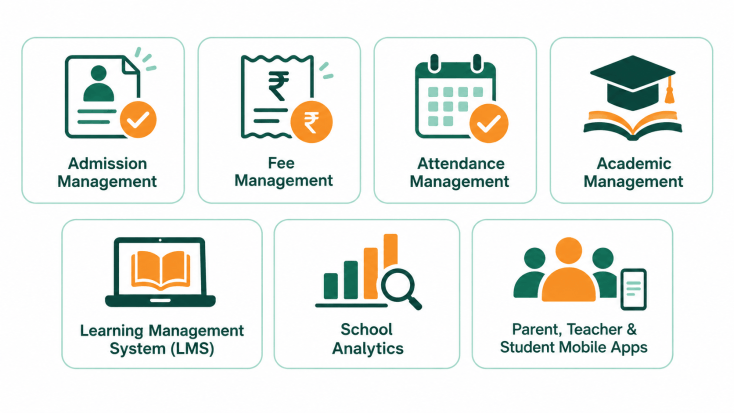
Features of smart erp software

  • Admission Management: Organise admission enquiries, registrations, and student records.
  • Fee Management: Manage fee structures, collections, payment records, and reminders.
  • Attendance Management: Maintain student and staff attendance records.
  • Academic Management: Manage examinations, grading, and academic activities.
  • Learning Management System: Share digital learning resources and educational content.
  • School Analytics: Access reports and dashboards for better operational visibility.
  • Mobile Applications: Support communication between parents, teachers, and students.

Why Consider eduTinker?

eduTinker is worth considering for schools looking for a unified school ERP platform that combines administrative automation, academic management, and digital learning. Its integrated approach helps reduce repetitive work and keeps important school information organised.

2. Entab CampusCare – Comprehensive School ERP

Entab CampusCare provides school management solutions covering academic and administrative requirements. Its platform supports institutions in managing student information, admissions, examinations, fee collection, and communication.

Key Features:

  • Admission and student information management
  • Fee collection and accounting
  • Attendance and examination management
  • Transport and library management
  • Staff management and payroll
  • Parent communication and mobile applications
  • Academic reports and dashboards

Why Consider It?

Schools looking for a broad range of administrative modules can explore CampusCare to manage multiple departments through a connected system.

3. Fedena – Flexible School Management System

Fedena offers modular school management solutions for handling administrative and academic activities. Its platform supports student records, examinations, fee management, and other institutional processes.

Key Features:

  • Student information and admission management
  • Fee collection and payment integrations
  • Examination and grade management
  • Library and transport management
  • Timetable and attendance management
  • Mobile applications and integrations

Why Consider It?

Fedena can be considered by schools looking for a modular platform with different management capabilities. Institutions should review the available plans and integrations before choosing a solution.

4. MyClassboard – School Administration and Communication

MyClassboard provides digital solutions for school administration, academic management, and parent communication. Its platform helps institutions organise student information and coordinate activities between teachers, parents, and administrators.

Key Features:

  • Student admission and information management
  • Fee management and online payments
  • Attendance and examination records
  • Parent and teacher communication
  • Transport and hostel management
  • Academic reports and performance tracking
  • Mobile applications and notifications

Why Consider It?

Schools looking to improve parent engagement while managing their daily administrative activities can explore MyClassboard.

5. Vidyalaya – School ERP for Administrative Automation

Vidyalaya offers school ERP solutions designed to support academic and administrative operations. Its platform includes modules for managing student information, fees, attendance, examinations, and other institutional activities.

Key Features:

  • Admission and student information management
  • Fee collection and financial records
  • Attendance and examination management
  • Transport and hostel management
  • Library and inventory management
  • Staff and payroll management
  • Reports and dashboards

Why Consider It?

Vidyalaya is an option for schools looking to automate multiple departments through a single management platform.

6. Skolaro – Cloud-Based School Management Software

Skolaro provides cloud-based school ERP solutions for managing academic and administrative activities. Its platform helps institutions maintain student records, manage fees, track attendance, and coordinate school operations.

Key Features:

  • Online admission management
  • Student and staff information management
  • Fee management and online payments
  • Attendance tracking and notifications
  • Examination and academic management
  • Parent, teacher, and student applications
  • School analytics and management reports

Why Consider It?

Schools seeking cloud-based access and centralised management can consider Skolaro when comparing school ERP platforms.

7. Edunext – School ERP with Digital Learning Features

Edunext provides school management solutions that support administrative processes and academic activities. Its platform combines ERP capabilities with digital learning and communication tools.

Key Features:

  • Online admission management
  • Student information management
  • Fee collection and payment records
  • Attendance and examination management
  • Timetable and academic management
  • Digital learning tools
  • Parent communication and mobile applications


Why Consider It?

Edunext can be explored by schools looking to combine administrative automation with digital learning support.

Software

Main Focus

eduTinker

Integrated ERP, LMS and school analytics

Entab CampusCare

Comprehensive school administration

Fedena

Modular school management

MyClassboard

Administration and parent communication

Vidyalaya

Multi-department automation

Skolaro

Cloud-based school management

Edunext

ERP and digital learning

This is a comparative shortlist, not an independently verified ranking. Features may vary by subscription and implementation.

Before selecting a school management system, evaluate whether it supports your institution’s daily requirements.

1. Admission Management

A good admission management system simplifies the admission journey, from online enquiries and registrations to document collection and student enrolment. It also helps schools track applications and monitor admission conversion.

2. Fee Management

The best fee management software should support customisable fee structures, instalments, online payments, automated receipts, reminders, and outstanding dues tracking. These features help schools maintain organised financial records.

3. School Analytics and Reporting

School analytics provides useful insights into attendance, fee collection, admissions, examination results, and overall school performance. Dashboards help principals and administrators make informed decisions.

4. Attendance Management

Digital attendance management helps teachers record attendance and allows administrators to monitor student and staff attendance patterns. Some ERP platforms also offer biometric and RFID integrations.

5. Academic and Examination Management

Look for features such as examination scheduling, marks entry, grading, report card generation, and academic performance tracking.

6. Parent and Student Applications

Mobile applications improve communication by allowing parents to access attendance updates, academic information, fee details, and important notifications.

7. Cloud Access and Data Security

Cloud-based school ERP software provides access to information through supported devices and locations. Check data backups, user permissions, security practices, and data ownership before implementation.

Choosing the right ERP software requires more than comparing feature lists. Schools should evaluate their current processes, budget, and future requirements.

Consider these factors:

  • Identify your requirements: Decide which activities need automation, such as admissions, fee collection, attendance, or academics.
  • Compare essential features: Ensure the software covers the modules your school actually needs.
  • Check ease of use: Choose an intuitive platform that teachers, administrators, and parents can use comfortably.
  • Evaluate ERP pricing: Compare subscription charges, implementation costs, additional modules, and maintenance expenses.
  • Review integrations: Check compatibility with payment gateways, SMS services, accounting tools, and biometric devices.
  • Request a product demo: Understand how the software handles your school’s actual workflows.
  • Check customer support: Evaluate implementation assistance, training, technical support, and data migration.


What Is the Best School Software for Public Schools?

The best school software for public schools should support student records, attendance tracking, examination management, administrative reporting, and communication.

Public institutions may also require affordable pricing, easy accessibility, and reporting capabilities aligned with their specific administrative and board requirements. Always confirm these requirements with the software provider before implementation.

School ERP pricing in India varies according to the provider, student strength, selected modules, and implementation requirements.

Common pricing factors include:

  • Number of students and staff members
  • Modules included in the subscription
  • Number of school branches
  • Mobile application requirements
  • Cloud hosting and storage
  • Customisation and integrations
  • Training and implementation charges

Some providers offer per-student pricing, while others use monthly or annual subscription models.

Instead of choosing the cheapest option, schools should compare the overall cost with the features, support, and long-term value offered by the platform.

Implementing the right school management system can help institutions:

  • Reduce administrative workload: Automate repetitive tasks and minimise manual recordkeeping.
  • Improve fee management: Organise collections, payment records, and outstanding dues.
  • Simplify admissions: Manage enquiries, registrations, and enrolments efficiently.
  • Improve communication: Connect parents, teachers, students, and administrators.
  • Access better insights: Use school analytics to review operational and academic performance.
  • Maintain organised records: Keep important student and institutional information centralised.

Frequently Asked Questions

1. Which is the best school management software in India for 2027?

The right software depends on your school's requirements, budget, and preferred features. eduTinker, Entab CampusCare, Fedena, MyClassboard, Vidyalaya, Skolaro, and Edunext are platforms worth exploring.

2. What are the essential features of school ERP software?

Essential features include admission management, fee management, attendance, academic management, examination management, school analytics, parent communication, and mobile applications.

3. How much does school ERP software cost in India?

Pricing depends on student strength, selected modules, integrations, and implementation requirements. Contact providers for customised quotations.

4. How do I find the best-rated school ERP software in India?

Compare verified customer reviews, ratings, features, customer support, and implementation experience. Request a product demonstration before making a decision.

5. Which is the best school software for public schools?

The best solution should provide reliable student information management, attendance tracking, examination records, administrative reporting, and affordable pricing.

6. Why should schools choose cloud-based ERP software?

Cloud-based ERP software allows authorised users to access school information through supported devices. It also helps connect departments and maintain centralised records.
Tags

About the author

Picture of eduTinker

eduTinker

Contact us

Related Blogs

Explore helpful articles on admissions, academics, technology, and student engagement.