
Running a school is a full-time job. There are students to look after, teachers to coordinate, parents to communicate with, fees to track, examinations to organize, and records that need to be updated regularly. On top of that, school administrators have to make sure that everyday operations continue without unnecessary delays.
This is where a School Management System can make a practical difference.
A School Management System is a digital platform that helps schools manage their academic, administrative, financial, and communication activities in one place. Instead of depending on registers, spreadsheets, paper files, and separate applications, schools can bring important information and processes together through a single system.
But the real value of school management software is not simply that it makes a school “digital.” It is about making everyday work easier to manage.
What Is a School Management System?
A School Management System is software that helps educational institutions manage and organize their day-to-day school operations through a centralized digital platform.
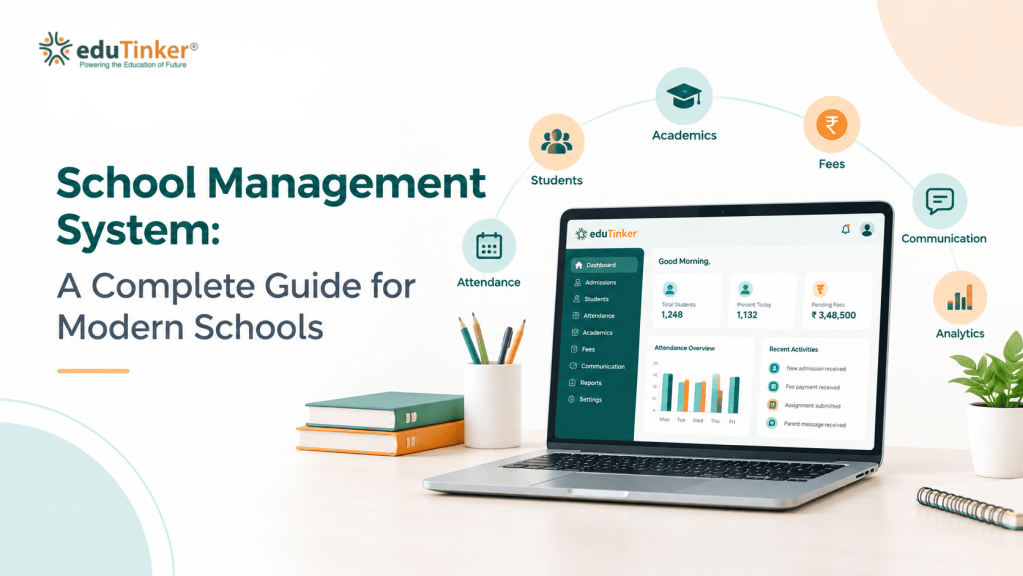
It can connect areas such as student records, admissions, attendance, fees, examinations, academics, staff management, communication, and reporting.
For example, when a student joins a school, their information can be added to a digital profile. That same profile can later be used for attendance, academic records, examination results, fee information, and communication.
This means staff do not have to repeatedly enter or search for the same information in different places.
The exact modules available depend on the software provider. However, a complete school management system generally aims to connect the different parts of school administration rather than treating every department as a separate process.
Why Are Schools Using Management Software?
Think about a typical school office.
One employee may be checking admission documents. Another may be updating student records. The accounts team may be following up on pending fees, while teachers are submitting attendance or marks. Meanwhile, parents may be calling the school for updates.
None of these tasks is particularly unusual. The challenge comes from handling all of them at the same time.
When information is scattered across different files and systems, even a simple request can take longer than it should. A digital school management system can give staff one place to work from.
This approach is not new. Government documentation on school management software has highlighted objectives such as reducing manual work and data redundancy, improving access to updated information, standardizing processes, and bringing school tasks onto a common platform.
What Does a School Management System Include?
A school does not operate through one department alone. That is why useful school management software usually includes several connected modules.
Here are some of the most important ones.
Student Information Management
Student records are used throughout a child’s journey at school.
A school management system can maintain student profiles along with information such as class, section, parent details, documents, attendance, academic records, and other relevant information.
Having this information digitally organized means authorized staff can find the required record without searching through multiple physical files.
It also gives the school a more consistent source of student information.
Admission Management
Admissions can be one of the busiest periods of the academic year.
There may be enquiries, applications, document submissions, verification, selection, fee payments, and final enrolment to manage.
With an online admission module, schools can keep track of applications and student information digitally. This can make it easier for staff to follow the status of an application and reduce unnecessary paperwork.
Attendance Management
Attendance is recorded every school day, so even a small inefficiency can become a significant administrative burden over time.
A school attendance management system allows teachers to record attendance digitally and helps schools maintain attendance histories and reports.
Depending on the platform, parents may also receive attendance-related notifications or view attendance information through a parent application.
Fee Management
Fee collection involves more than simply recording whether a payment has been made.
Schools may have different fee heads, instalments, due dates, discounts, late charges, payment methods, and receipts to manage.
A fee management system can help schools organize these details, track outstanding amounts, record payments, generate receipts, and maintain fee-related reports.
For parents, online payment facilities can make the payment process more convenient.
Examination Management
Examinations create another layer of administrative work.
Schools need to prepare schedules, collect marks, calculate results, generate report cards, and maintain academic records.
Digital examination management can reduce some of the manual work involved in these processes. It can also keep examination information connected to individual student records.
Academic Management
A school management system may also include tools for managing day-to-day academic activities. Depending on the software, teachers can manage assignments, assessments, academic records, and other classroom-related information.
This gives schools a better way to keep academic information organized instead of maintaining separate records for every activity.
Staff Management
Students are not the only records schools need to maintain.
Teachers and other employees also have information that needs regular updating. Staff management features can help schools maintain employee profiles, attendance, leave information, designations, and other administrative records.
Some platforms also provide payroll-related functionality.
Parent Communication
Parents expect schools to keep them informed.
Whether it is an announcement, attendance update, fee reminder, examination information, or general school notice, communication needs to reach families in a timely manner.
A school management system can provide digital communication channels that make it easier for schools to share relevant information.
Instead of relying entirely on printed notices or individual phone calls, schools can use centralized communication tools.
Reports and School Analytics
Schools collect a lot of information. The important question is what they do with it.
Reports and dashboards can turn day-to-day data into information that administrators can actually use. For example, school leaders may want to look at attendance patterns, fee collections, admission numbers, academic results, or other operational information.
A centralized system can make this information easier to review and compare.
How Does a School Management System Help Teachers?
Teachers already have a lot on their plate.
They need to prepare lessons, teach classes, assess students, communicate with parents, and complete administrative work.
A school management system can reduce some of the routine work around these responsibilities.
For example, instead of maintaining a separate attendance register and later submitting the information to another department, teachers can record attendance directly in the system. Similarly, academic information and marks can be entered digitally, depending on the platform.
The idea is not to add another task for teachers. A well-designed system should remove unnecessary steps from the tasks they already perform.
Must Read: Why ERP Is Important for Schools in India
How Does It Help Parents?
Parents often need information from the school but may not always have the time to visit the school office.
A parent-facing school management system can give them access to relevant information digitally.
Depending on the features available, parents may be able to check:
- Attendance
- Academic updates
- Examination information
- Fee status
- Payment receipts
- School announcements
- Other student-related information
This can make everyday communication more convenient and reduce the need for repeated enquiries.
How Does It Help School Administrators?
For administrators, the biggest advantage is having better visibility.
When different school functions are connected, administrators can access information without collecting separate reports from every department.
For instance, a principal may need to understand the current fee collection status or review attendance information. With centralized reporting, this information can be available through the system rather than requiring several manual steps.
This can support faster administrative decision-making and reduce the amount of time spent compiling routine information.
What Are the Main Benefits of a School Management System?
The benefits will vary depending on the software and how effectively the school implements it. However, a well-integrated system can provide several practical advantages.
Less Repetitive Administrative Work
Digital processes can reduce repeated data entry and paperwork.
Better Organized Information
Important school records can be stored in a structured digital environment instead of being spread across different files and registers.
Faster Access to Records
Authorized users can find relevant information without going through multiple physical documents.
Easier Fee Tracking
Schools can monitor payments, outstanding amounts, receipts, and fee-related information more systematically.
More Convenient Communication
Schools can share relevant updates with parents, teachers, and students through digital channels.
Better Reporting
Administrators can generate reports from the information already available in the system instead of preparing every report manually.
Greater Visibility Across Departments
When modules are connected, different departments can work with consistent information rather than maintaining isolated records.
These are also consistent with documented objectives for school-management systems, including improved operational management, better access to transaction data, reduced manual work, and reduced data redundancy.
What Is a Cloud-Based School Management System?
A cloud-based School Management System stores and operates through online infrastructure, allowing authorized users to access the software through internet-connected devices.
This can be useful for schools that want access from different locations or devices.
For example, a principal may need to review a report outside the administrative office, or a teacher may need to access the system through a mobile device.
However, schools should not choose a cloud platform simply because it is accessible online.
Before selecting a provider, schools should ask about:
- Data security
- User permissions
- Backup procedures
- Data privacy
- System reliability
- Mobile access
- Customer support
- Data ownership and export options
The technology should serve the school, not create another administrative headache.
School Management System vs. Manual Management
The difference between manual and digital management is often visible in small everyday tasks.
With manual processes, an administrator may need to search through a register to find a student’s information, check another file for fee details, and contact a teacher separately for attendance information.
With an integrated system, these records can be connected to the student’s digital profile.
That does not mean every task becomes automatic. Schools still need people to verify information, make decisions, communicate with families, and handle situations that require judgment.
The difference is that technology can take care of more of the repetitive record-keeping around those responsibilities.
How to Choose the Right School Management System
There is no single system that will be perfect for every school.
A small school may have different requirements from a large institution with multiple campuses. Some schools may prioritize fee management, while others may need stronger academic, examination, or communication features.
Before making a decision, school leaders should look at the actual problems they want the software to solve.
Ask questions such as:
Does it cover our daily school processes?
The system should support the areas the school actually uses rather than offering dozens of unnecessary features.
Is it easy for teachers to use?
A complicated system can make adoption difficult. Teachers and administrators should be able to understand the basic workflows without excessive training.
Can different modules work together?
Integration matters. Student information, attendance, academics, examinations, and fees become more useful when they are connected.
Can parents access relevant information?
If parent communication is a priority, check whether the system provides a suitable portal or mobile application.
Can the system grow with the school?
The software should be able to handle increasing students, users, departments, or campuses if the school expands.
What support is available?
Implementation does not end when the software is purchased. Training, troubleshooting, updates, and customer support can make a significant difference.
How eduTinker Can Support School Management
For schools looking to bring their everyday operations into one digital environment, eduTinker provides an integrated school management platform covering multiple areas of school administration.
The platform can support processes including admissions, student information, attendance, academics, examinations, fee management, communication, staff management, reporting, and school analytics.
The advantage of bringing these areas together is that schools can work with connected information instead of depending on several disconnected tools.
For school administrators, this can mean better visibility into everyday operations. For teachers, it can mean fewer repetitive administrative tasks. For parents, it can provide easier access to relevant school information.
The exact value, of course, depends on how a school configures and uses the platform according to its own processes.