
The education landscape in 2026 is undergoing a significant transformation, driven by rapid technological advancements and evolving expectations from students, parents, and educators. Schools that aim to remain competitive and future-ready are increasingly adopting digital solutions, with ERP systems for schools emerging as a central pillar of this transformation.
What was once considered a back-office management tool has now evolved into a comprehensive digital ecosystem. Modern School ERP platforms are not only streamlining administrative processes but also enhancing learning experiences, improving communication, and enabling data-driven decision-making.
For institutions exploring the Best school ERP, understanding current trends is essential to making informed and strategic investments.
Why Schools in India Are Investing in ERP
In India’s highly competitive education sector, schools are under constant pressure to deliver quality education while maintaining operational efficiency. Traditional manual systems and fragmented tools are no longer sufficient to handle the complexity of modern school management.
This has led to a growing adoption of School ERP in India, where institutions are transitioning toward centralized platforms that integrate all functions into a single system.
A robust ERP system for schools enables seamless management of:
- Admissions and enrollment processes
- Attendance tracking and academic records
- Fee collection, accounting, and financial reporting
- Communication between parents, teachers, and administration
By digitizing these operations, schools can achieve higher efficiency, better transparency, and improved stakeholder satisfaction.
Also Read: Why Schools in India Are Rapidly Adopting ERP Software
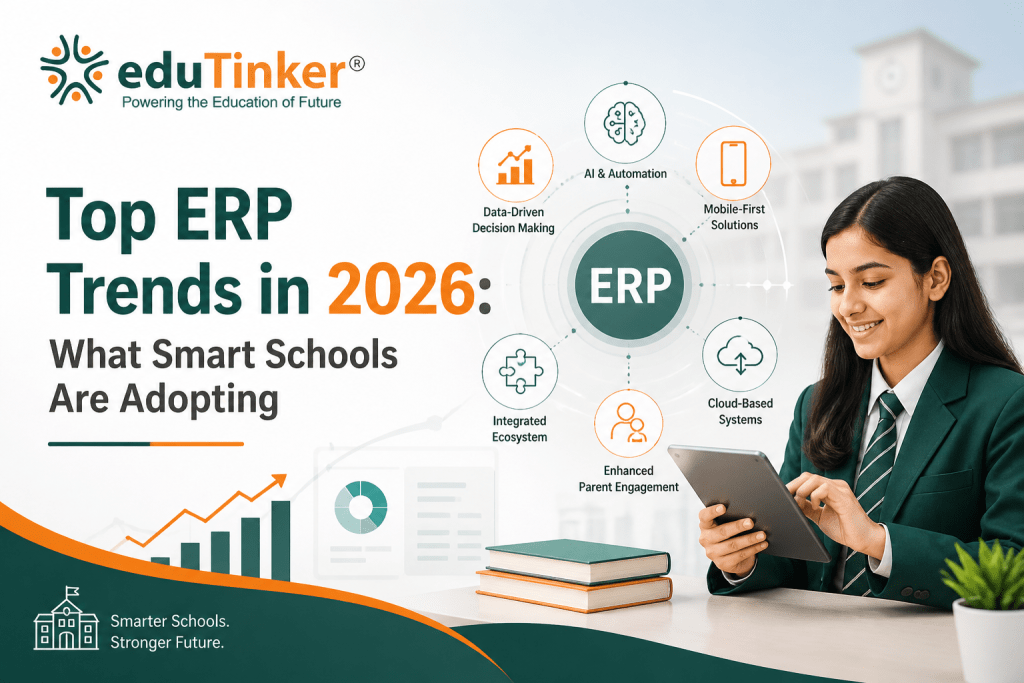
Top ERP Trends in 2026
1. AI-Powered ERP for Smarter Decision-Making
Artificial Intelligence is playing a transformative role in modern School ERP platforms. Today’s systems go beyond data storage and offer intelligent insights that support better academic and administrative decisions.
AI-powered ERP solutions can:
- Predict student performance trends
- Identify learning gaps at an early stage
- Automate grading, reporting, and evaluations
This shift enables schools to move from reactive to proactive decision-making, ultimately improving student outcomes.
2. Cloud-Based School ERP Platforms
Cloud technology has become the backbone of modern ERP systems. Schools are increasingly adopting cloud-based School ERP in India solutions due to their flexibility and cost-effectiveness.
Key advantages include:
- Anytime, anywhere access for students, teachers, and administrators
- Reduced infrastructure and maintenance costs
- Easy scalability as the institution grows
Cloud-based ERP systems are particularly beneficial for schools operating across multiple locations or offering hybrid learning models.
3. Integration of School LMS with ERP
One of the most significant developments in 2026 is the seamless integration of School LMS with ERP systems. This integration creates a unified digital environment that combines academic and administrative functionalities.
With this approach:
- Teachers can manage lessons, assignments, and assessments within one platform
- Students gain easy access to study materials and progress tracking
- Administrators can monitor academic performance alongside operational metrics
This convergence enhances both teaching efficiency and learning engagement.
4. Mobile-First ERP Experience
With the widespread use of smartphones, schools are prioritizing mobile accessibility in their ERP solutions. Modern School ERP platforms are designed with mobile-first capabilities to ensure ease of use for all stakeholders.
Mobile-enabled ERP systems allow users to:
- Track attendance and academic updates in real time
- Receive instant notifications and alerts
- Communicate seamlessly across the school ecosystem
This accessibility improves engagement and ensures continuous connectivity.
5. Data-Driven Insights and Advanced Analytics
Data is becoming a critical asset in the education sector. The Best school ERP systems now include advanced dashboards and analytics tools that provide actionable insights.
Schools can analyze:
- Student performance trends and academic progress
- Attendance patterns and behavioral indicators
- Financial data and operational efficiency
These insights empower institutions to make informed decisions and continuously improve their processes.
6. Automation of Administrative Processes
Automation remains one of the most impactful benefits of ERP adoption. Tasks that were once time-consuming and prone to errors can now be executed efficiently.
ERP for schools enables automation of:
- Admission workflows and documentation
- Fee collection, invoicing, and reminders
- Report card generation and performance reports
This significantly reduces administrative workload, allowing staff to focus on strategic and educational priorities.
7. Enhanced Data Security and Compliance
As schools handle sensitive student and financial data, security has become a top priority. Modern School ERP in India solutions incorporate advanced security measures to safeguard information.
These include:
- End-to-end data encryption
- Role-based access controls
- Secure cloud storage and regular backups
Such features ensure compliance with data protection standards and build trust among stakeholders.
8. Modular and Scalable ERP Solutions
Every institution has unique requirements, and a one-size-fits-all approach is no longer effective. Modular ERP solutions allow schools to select features based on their current needs and expand as they grow.
This flexibility makes ERP systems more accessible and cost-efficient, especially for small and mid-sized institutions.
9. Paperless and Eco-Friendly Operations
Sustainability is becoming an important focus in education. By adopting digital workflows, schools can significantly reduce their reliance on paper.
School ERP platforms support:
- Digital records and documentation
- Online communication and reporting
- Automated workflows that eliminate manual paperwork
This not only reduces costs but also aligns with environmentally responsible practices.
10. Improved Parent Engagement and Communication
Effective communication with parents is essential for student success. Modern ERP systems are equipped with tools that enhance transparency and engagement.
Features include:
- Real-time updates on student performance
- Instant messaging between parents and teachers
- Notifications for attendance, homework, and events
These capabilities strengthen relationships and foster greater trust between schools and families.
Benefits of Using School ERP
Implementing a modern ERP system for schools offers numerous advantages:
- Centralized management of academic and administrative functions
- Improved communication and transparency across stakeholders
- Enhanced tracking of student performance and progress
- Reduced manual workload and operational inefficiencies
- Increased productivity and institutional scalability
Schools that adopt advanced School ERP platforms are better positioned to adapt to evolving educational demands.
Final Thoughts
In 2026, the adoption of School ERP in India is no longer a luxury but a necessity. Institutions that invest in the Best school ERP solutions gain a significant competitive advantage by streamlining operations and enhancing the quality of education they deliver.
From AI-driven insights to seamless School LMS integration, the latest trends clearly indicate that ERP systems are shaping the future of education. Schools that embrace these innovations today will be better prepared to meet the challenges of tomorrow.
FAQs
1. What is the Best School ERP?
The Best school ERP is a comprehensive platform that combines automation, cloud access, AI capabilities, and seamless integration with tools like School LMS.
2. Why is School ERP in India important?
A School ERP in India helps institutions improve efficiency, enhance communication, and successfully transition to digital operations.
3. What are School ERP platforms?
School ERP platforms are integrated software systems designed to manage academic, administrative, and financial processes in a centralized manner.
4. How does an ERP system for schools improve efficiency?
It automates routine tasks, reduces manual errors, and provides real-time insights, enabling smoother operations.
5. What is the role of School LMS in ERP?
School LMS integration enables effective learning management, while ERP handles administrative tasks, creating a unified ecosystem.
6. Is ERP for schools suitable for small schools?
Yes, modular ERP solutions allow small schools to start with essential features and expand as needed.
7. How do I choose the right School ERP platform?
Consider factors such as scalability, user-friendliness, security, cloud capabilities, and integration options before making a decision.