

Managing school admissions is an important responsibility for every educational institution. From receiving applications and verifying documents to communicating with parents and confirming enrolments, the admission process involves several tasks that require careful coordination. When these activities are handled manually, schools may face delays, misplaced records, repeated paperwork, and missed admission opportunities.
This is where admission management software for schools in India can make a real difference. It helps schools organise applicant information, simplify registration, track applications, and make the admission journey more convenient for parents and administrators.
With a digital approach, schools can reduce repetitive work, improve communication, and make better use of their admission data. eduTinker brings admission management together with other school management functions, helping institutions manage their daily operations through a connected digital platform.
Admission management software is a digital solution that helps schools manage the admission process from initial enquiry to student enrolment. It brings important admission activities into one place, making it easier for staff to access applicant information and follow each application’s progress.
Instead of maintaining separate registers, spreadsheets, and paper files, schools can use a centralised system to organise registration details, monitor applications, and manage admission-related communication.
For Indian schools handling admissions across different classes, such software can help establish a more organised process. Whether a school receives applications throughout the year or during a specific admission season, digital tools can make the workload easier to manage.
The expectations of parents are changing. Many families prefer to explore schools online, enquire about available seats, understand admission requirements, and submit information without making repeated visits to the campus.
At the same time, school administrators need to manage a growing volume of enquiries while ensuring that every applicant receives appropriate attention.
A digital admission process can help schools address these expectations in several ways.
Less paperwork and better organisation: Digital records make applicant information easier to maintain and retrieve. Staff members spend less time searching through physical files and updating multiple registers.
Convenient registration: An online registration facility allows parents to submit the required information through a digital interface, wherever the school provides this option.
Improved communication: Schools can keep parents informed about application progress, missing documents, important dates, and the next steps in the admission process.
Better application tracking: Administrators can review applications at different stages and identify cases that require follow-up.
More informed decisions: Admission reports can help school management understand enquiry volumes, application progress, and admission conversion trends.
By adopting easy admission management software, schools can create a process that is more organised for staff and more convenient for families.
When choosing admission management software, schools should look beyond basic registration. The right solution should support the complete admission workflow and connect with other administrative activities wherever possible.
1. Applicant Registration Feature
The applicant registration feature is an important starting point for a digital admission process. It helps schools collect essential information about prospective students in an organised format.
Depending on the system, registration may include student details, parent or guardian information, class preferences, contact details, and supporting documents.
A structured registration process reduces the need to enter the same information repeatedly. It also makes applicant records easier to review when the school receives a large number of applications.
2. Online Admission Management
Online admission management allows schools to handle admission-related activities digitally instead of depending entirely on paper-based processes.
Parents can complete registration and provide the required details through the available online facilities. School staff can then review applications, check submitted information, and manage the next steps according to the institution’s admission policy.
For schools with busy admission seasons, this approach can reduce administrative pressure and help staff maintain a more consistent workflow.
3. Admission Tracking and Follow-Ups
Not every enquiry immediately results in an application, and not every application leads to enrolment. Schools need a clear view of where prospective students stand in the admission journey.
Admission tracking helps staff identify enquiries, pending applications, incomplete submissions, and cases awaiting further action, depending on the system’s capabilities.
Timely follow-ups can help parents get answers to their questions and prevent interested families from being overlooked.
4. Admission Conversion Monitoring
Admission conversion refers to the percentage of prospective applicants or enquiries that eventually become confirmed admissions. Monitoring this figure can help schools evaluate the effectiveness of their admission activities.
For example, a school may receive 200 enquiries and successfully enrol 50 students. If the school measures conversion from enquiries to enrolments, its admission conversion rate is 25%.
Admission data can help administrators understand which stages experience delays and where additional communication may be useful. However, conversion rates should always be interpreted alongside factors such as available seats, eligibility requirements, and the school’s admission policy.
5. Centralised Student Information
Once an applicant becomes an enrolled student, maintaining accurate records becomes essential. A connected admission and student information system can help reduce repeated data entry and make it easier to carry relevant information into subsequent administrative processes.
This creates a more organised transition from admission to regular school operations.
Schools need more than a way to collect admission forms. They need a system that supports administrative efficiency while making the experience easier for parents.
eduTinker’s admission management solution can be positioned as part of its wider school management platform, helping institutions connect admission activities with their other day-to-day responsibilities.
A Smoother Admission Journey
A structured digital workflow helps schools organise applications and manage admission-related tasks more efficiently. Parents can receive clearer instructions about the information required and the steps involved, while staff can access relevant applicant records more easily.
The result is a more organised admission journey for both families and school administrators.
Better Use of Administrative Time
Admission teams often spend considerable time checking forms, updating records, answering repeated queries, and tracking pending applications. Digital processes can reduce some of this repetitive work, allowing staff to focus more on applicant support and admission coordination.
Improved Visibility into Admission Activities
Organised admission data helps school leaders review the progress of applications and identify areas that require attention. When this information is considered alongside other school reports, management can make better-informed operational decisions.
Connected School Operations
Admissions do not operate independently of fees, academics, attendance, and student records. A School ERP platform brings these important functions closer together, helping schools reduce information gaps and maintain more consistent records.
The specific workflows and automation available will depend on the features enabled for the institution.
A school may use separate tools for admission enquiries, fee collection, student records, communication, and academic management. Although each tool may solve an individual problem, disconnected systems can create duplicate work and make it difficult to maintain accurate information.
Cloud ERP and School ERP software offer a more connected approach by bringing multiple administrative functions into a shared digital environment.
For example, admission records can support the creation of student profiles, while fee management can help schools organise applicable fee details. School analytics can provide a wider view of institutional operations.
Cloud-based access can also make it easier for authorised users to access information from different locations, subject to the system’s permissions and security arrangements.
For Indian schools comparing admission ERP in India, it is worth evaluating how well the admission module works with the rest of the school’s management system instead of considering registration as a standalone activity.
Other Features of the Best School ERP Software
Admission management is only one part of running a school. The best school ERP solution should also address the everyday administrative and academic needs of the institution.
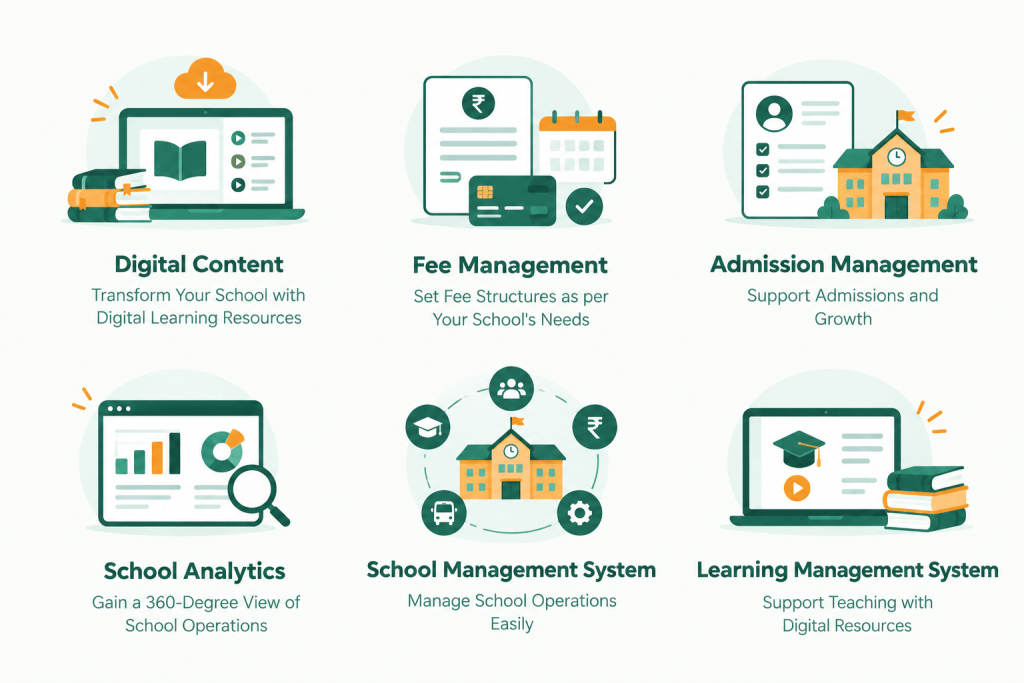
Digital Content: Transform Your School with Digital Learning Resources
Provide students with digital learning materials that support classroom teaching and make learning more accessible.
Fee Management: Set Fee Structures as per Your School’s Needs
Manage fee structures, payments, receipts, and outstanding dues in one place while simplifying fee collection and tracking.
Admission Management: Support Admissions and Growth
Manage enquiries, applications, and enrolments efficiently to create a smoother admission journey for parents and school staff.
School Analytics: Gain a 360-Degree View of School Operations
Use reports and dashboards to track admissions, attendance, fees, and student information for better decision-making.
School Management System: Manage School Operations Easily
Bring student records, attendance, fees, and staff information together on a centralised platform.
Learning Management System: Support Teaching with Digital Resources
Share digital study materials, distribute assignments, and support learning beyond the classroom with an organised digital learning environment.
How to Choose the Right Admission Management Software in India
Before selecting a solution, school management should consider the institution’s size, admission volume, existing processes, and plans for future growth.
Start by checking whether the software supports the complete admission workflow, including registration, application tracking, document handling, and relevant reporting. The system should be easy for staff to learn and convenient for parents to use.
Next, evaluate integration with fee management, student information, communication, and school analytics. A connected platform can be more useful than several independent tools if it fits the school’s requirements.
Data security is equally important. Ask about access permissions, data protection practices, backups, and the way student information is handled.
Schools should also review implementation support, training, customisation options, and pricing before making a decision.
For institutions searching for the top admission management for public school requirements, the selection criteria should include the school’s admission rules, documentation needs, reporting requirements, and the number of users who will work with the system.
The right software is not necessarily the one with the longest feature list. It is the one that solves the school’s actual problems and supports its admission process without adding unnecessary complexity.
Conclusion
Admission management plays an important role in creating a positive first impression of a school. When enquiries, registration, applications, and follow-ups are organised, administrators can manage their workload more effectively while helping parents understand the admission process.
For schools in India, smart admission management software can reduce repetitive paperwork, improve access to applicant information, and provide useful insights into admission conversion. When combined with fee management, school analytics, digital content, and a Learning Management System, it becomes part of a broader effort to simplify school operations.
eduTinker offers a school management platform that brings multiple school functions together. Schools can explore its available features to understand how a connected digital solution may support their admission and administrative needs.