

Ask most school principals in India how their school is performing, and they will give you a confident answer. They will talk about board exam results, parent satisfaction, and enrolment numbers. But ask them to show you the data behind that answer, real-time, structured, and easy to read, and many will pause.
That pause is costly. In an era where Indian schools face intense competition, rising parent expectations, and increasing regulatory oversight, running a school on instinct alone is no longer enough. The most forward-thinking school owners and trustees in India are now turning to school analytics software to understand what is actually happening in their institutions, and to act on it fast.
This blog explores how data and analytics are transforming school management in India, what school leaders can measure, and why the right school ERP with built-in analytics is becoming essential for sustainable school growth.
Why Most Indian Schools Are Flying Blind
Here is a situation that plays out in thousands of Indian schools every year. The principal sits in a meeting with the school’s trustees. The agenda is to review school performance for the academic quarter. The principal has prepared a report, but it took three days to compile. The data comes from four different registers, two staff members, and several spreadsheets.
By the time the report reaches the trustee, it is already two weeks old. Some of the figures may have errors. More importantly, the data describes what happened, not what is happening now. So the board makes decisions based on past data, often without the context they need.
This is the reality for most Indian schools, including many well-regarded CBSE and ICSE institutions. And it does not have to be this way.
School analytics software changes this dynamic entirely. Instead of waiting for a staff member to compile a report, school leaders can view live data, today, right now, on any device.
What School Analytics Actually Measures
When we talk about school analytics in the Indian context, we are not talking about complex algorithms or artificial intelligence research. We are talking about clear, actionable data across five key areas.
1. Student Performance and Academic Progress
How is each student performing across subjects? Which classes have the highest proportion of students struggling in mathematics? Which teachers are consistently delivering strong results? These questions can be answered with structured academic tracking built into a good school management system.
For CBSE and ICSE schools, this data is especially powerful. Board exam performance correlates strongly with consistent internal assessment tracking. When teachers and principals can see performance trends early — at the mid-year stage — they have time to intervene.
2. Attendance Patterns
Chronic absenteeism is one of the strongest predictors of student underperformance. Yet, in many Indian schools, attendance is still tracked in physical registers and reviewed only when a parent raises a concern.
A school analytics dashboard shows attendance patterns in real time — by student, by class, and by grade level. Additionally, it can flag students whose attendance has dropped below a threshold, triggering an automatic notification to parents and the class teacher.
3. Fee Collection and Financial Health
Financial analytics give school owners and trustees a clear picture of revenue health. How much fee is collected versus outstanding? Which classes have the highest default rates? How does this month’s collection compare to the same period last year? These insights help trustees plan cash flow and address financial risks before they escalate.
4. Admission Funnel Performance
Analytics can show exactly where prospective parents drop out of the admission process. For example, if a large number of parents fill out an enquiry form but do not complete the application, that signals a problem at a specific stage. Fixing that stage can significantly improve enrolment numbers.
5. Staff Performance and Utilisation
How many classes did each teacher conduct last week? What is the substitution rate in a particular grade? Are there patterns of recurring absenteeism among staff? This data helps principals manage human resources fairly and efficiently.
The Pain Points School Analytics Solves for Indian Leaders
Let us be specific about the challenges that school owners, principals, and trustees in India face — and how analytics addresses each one.
“I do not know which grade needs more academic attention until it is too late.” With student performance tracking built into your school ERP, early warning indicators appear automatically. Teachers and principals see academic trends before they become crises.
“I cannot tell which staff member is underperforming without relying on complaints.” Staff activity and class delivery data makes performance patterns visible — objectively and without bias.
“Our enrolment has plateaued, but I do not know why.” Admission funnel analytics show exactly where you are losing prospective parents. Consequently, you can make targeted improvements to specific steps in the process.
“Parents claim they paid a fee that is not in our records.” When all financial data flows through a connected analytics system, every payment is traceable and verifiable. This protects both the school and the parent.
“Trustees want monthly reports, but preparing them takes the principal’s entire weekend.” With an analytics dashboard, any authorised user can pull the exact report they need in seconds. Moreover, scheduled reports can be delivered automatically by email.
How School Analytics Connects to Broader School Growth
The value of school analytics extends beyond reporting. It changes how school leaders think about their institution.
When a principal in India can see that 32% of students in Class 7 are consistently below average in science, they can investigate the root cause. Is it the curriculum? Is it the teaching approach? Is it attendance-related? Once the cause is identified, a solution can be implemented — and the results can be tracked in the same system.
Similarly, when trustees can see that their school’s admission conversion rate has improved from 28% to 41% after a process change, they gain confidence in digital transformation initiatives. Furthermore, this data culture makes the entire organisation more accountable and more responsive.
In India’s competitive school market, this kind of intelligence is not a nice-to-have. It is a decisive advantage.
What to Look for in a School Analytics Platform in India
If you are evaluating school analytics software for your CBSE or ICSE school in India, consider these factors.
Integration with your school ERP: Analytics is most powerful when it draws data from a single, unified system — not from multiple disconnected tools. Therefore, look for a school management platform that includes analytics as a built-in module.
Mobile accessibility: School principals and trustees in India are often on the move. Your analytics dashboard should work perfectly on a smartphone, without requiring a desktop login.
Customisable reports: Every school has different reporting needs. Your platform should allow you to build custom reports — by date range, by grade, by teacher, or by any other variable relevant to your school.
Data privacy and security: Student data in India is sensitive. Your platform must store data securely and comply with applicable data protection standards.
Ease of use for non-technical staff: The best analytics platform is one that your principal can use without help from a technology team. Look for clean, intuitive dashboards with minimal training requirements.
How EduTinker Brings Analytics to Indian Schools
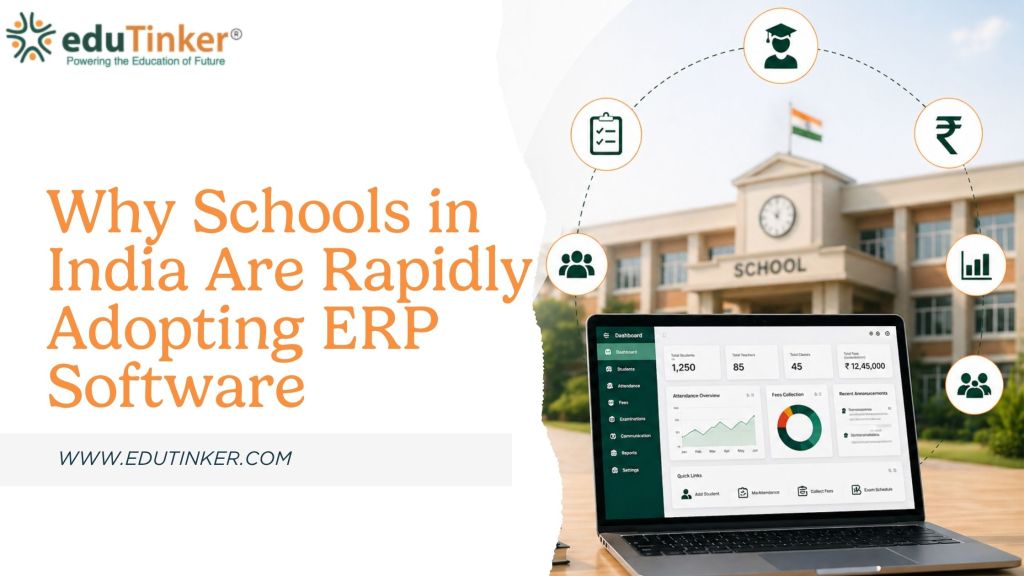
EduTinker’s school analytics module gives Indian school leaders a 360-degree view of their institution — from student performance and attendance to fee health and admission trends. Everything is visible in a single, clean dashboard that works on any device.
For school principals, the dashboard provides daily operational insights — which students are absent today, which classes have overdue fees, which grade is performing below average this term. For trustees and school owners, it provides strategic data — how the school is tracking against last year’s targets, where growth opportunities exist, and where risks are emerging.
Because EduTinker is a complete school ERP system, data flows automatically from every module — admissions, fees, attendance, academics — into the analytics layer. There is no manual data entry, and no risk of outdated reports.
Furthermore, EduTinker is built for the Indian school context. It supports CBSE and ICSE reporting requirements, understands the Indian academic calendar, and is used by schools across India — from Delhi to Kochi, from Mumbai to Patna.
Making the Move to Data-Driven School Management
The transition to data-driven school management does not have to be disruptive. Here is a simple approach for Indian school leaders.
Start by identifying the three decisions you make most often without enough data. Common answers include: how to address underperformance, how to improve admissions, and how to reduce fee defaults.
Next, look for a school ERP platform that tracks data relevant to each of those decisions. Evaluate how the data is presented — is it clear, real-time, and accessible to everyone who needs it?
Finally, commit to a culture shift. When staff know that data is being tracked and reviewed, accountability improves naturally. This is one of the most important and often overlooked benefits of school analytics.
Conclusion
The most successful school leaders in India today are not the ones who work the hardest — they are the ones who make the best decisions. And better decisions come from better data.
School analytics software gives Indian principals, school owners, and trustees the clarity they need to run smarter institutions. It replaces guesswork with insight, replaces delayed reports with real-time dashboards, and replaces reactive management with proactive leadership.
For CBSE and ICSE schools across India, platforms like EduTinker make this transition straightforward. From Day 1, you gain access to structured, actionable data across every function of your school — helping you grow enrolment, improve academic outcomes, and build a stronger institution for the long term.