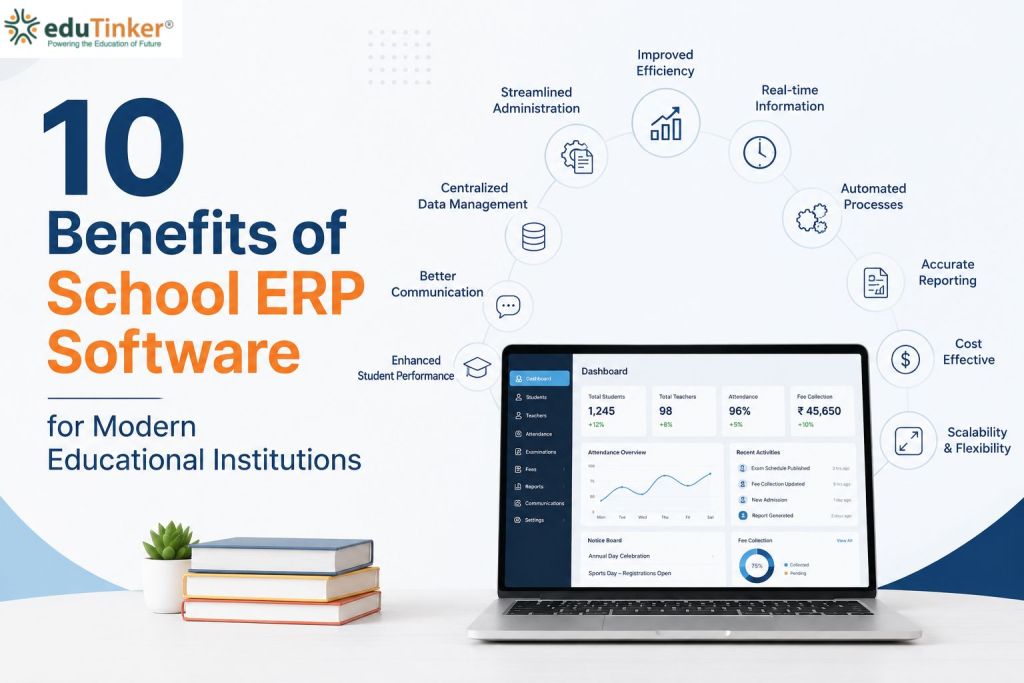


Running a private school in India in 2025 is significantly more expensive than it was a decade ago. Staff costs have risen. Infrastructure investments have grown. Parent expectations have increased. Yet, many school trustees still operate their institutions using manual processes that consume enormous amounts of time and money.
Here is a number that often surprises school owners: administrative tasks fee collection, attendance tracking, report card generation, parent communication, timetable management consume up to 40% of school staff time. This is time spent not on education but on paperwork. School ERP software directly attacks this waste, giving Indian school owners a clear path to lower costs and better outcomes. Let us break down exactly how.
Understanding Where Indian Schools Lose Money Operationally
Before exploring the solution, it is worth identifying where operational costs accumulate silently. First, manual fee collection is expensive. When schools collect cash fees, count money, issue physical receipts, and reconcile ledgers manually, they need more accounts staff to manage the volume. Additionally, errors and disputes require even more time to resolve.
Second, physical stationery printed report cards, fee receipts, attendance registers, admission forms, notices, and letters adds up significantly over a year. Schools with 800 or more students spend surprising amounts on paper, printing, and storage alone.
Third, staff overtime during report card season, admission cycles, and exam periods drives up personnel costs. When these processes are manual, the workload spikes predictably every term and schools either pay overtime or accept delays.
Finally, poor data management leads to costly errors. Incorrect fee entries, lost student records, and miscommunicated exam schedules generate disputes that consume hours of senior staff time to resolve.
How School ERP Software Reduces These Costs
A well-implemented school ERP addresses all of the above pain points simultaneously. Moreover, the financial impact compounds over time as the system learns the school’s processes and staff become more proficient.
Automated fee collection through integrated payment gateways reduces the need for dedicated accounts staff to spend hours on manual collection. Because parents pay online and receipts are generated automatically, the entire process runs with minimal human intervention. Schools typically report a 30–40% reduction in accounts team workload within the first year of implementation.
Digital report cards generated directly from the ERP eliminate weeks of manual data entry every term. Teachers enter marks once, and the system produces formatted, branded report cards automatically. Consequently, printing costs fall, distribution is instant, and errors become rare.
Automated attendance marking through biometric or app-based check-ins eliminates the daily register routine. Furthermore, late fee calculations and leave management for staff become automated, reducing payroll processing time substantially.
Centralised timetable management prevents the scheduling conflicts that consume hours of coordinator time every new academic session. Because the ERP tracks teacher availability, room assignments, and class requirements simultaneously, conflicts are flagged before they become problems.
The ROI Case for Indian School Trustees
School trustees in India are increasingly asking for ROI clarity before adopting any new technology. The numbers for school ERP software are compelling. Consider a school with 1,000 students and 60 staff members. If administrative inefficiency consumes 40% of non-teaching staff time, and each staff member’s monthly cost is Rs 25,000, the annual cost of manual processes is significant potentially exceeding Rs 30 lakhs per year in lost productivity alone.
Additionally, revenue leakage from delayed or missed fee collections, incorrect concession management, and poor defaulter tracking adds further financial pressure. A school ERP that automates these processes typically delivers measurable fee collection improvement within the first admission cycle.
Cloud-Based ERP: Lower Cost, Faster Setup for Indian Schools
One of the biggest shifts in school ERP adoption across India is the move to cloud-based platforms. Unlike traditional on-premise software that required expensive servers and IT maintenance, cloud ERP runs on the internet and is accessible from any device.
This is particularly valuable for Indian school owners managing multiple campuses. Because all data is centralised, a trustee can review consolidated performance across all branches from a single dashboard. Furthermore, cloud updates happen automatically, so schools always run the latest version without paying for upgrades.
CBSE and ICSE Compliance Made Simpler
School ERP software built for Indian schools ensures that all data management, fee structures, and reporting conform to CBSE and ICSE compliance requirements. Because the system generates regulation-ready reports automatically, schools spend less time preparing documentation for affiliation renewals and board inspections.
The EduTinker Advantage
EduTinker’s school ERP is purpose-built for Indian private schools. It combines fee management, admission tracking, attendance, analytics, communication, and digital content in one integrated platform. Because everything connects, schools eliminate the cost and complexity of managing multiple software tools. Additionally, EduTinker’s implementation team provides hands-on support, ensuring Indian school owners achieve operational improvements quickly without disrupting academic continuity.
Conclusion
The question for Indian school trustees in 2025 is not whether to adopt a school ERP it is how quickly they can make the transition. Every month spent on manual processes is a month of recoverable cost that goes unrecovered. Every term without automation is a term of staff time spent on paperwork instead of education. For school owners serious about building sustainable, efficient institutions, school ERP software is not just a technology decision. It is a financial strategy.